

What is Smart Money, and How Does It Work?
Smart Money refers to the substantial capital managed by banks, financial institutions, and other large market participants. These entities possess distinct advantages, including access to sophisticated data, the ability to execute large-scale orders, and significant liquidity. Consequently, their actions directly influence price movements. The Smart Money Concept aims to identify the behavioral patterns of these institutions, enabling traders to align their trading decisions with institutional liquidity. Financial institutions commonly utilize order blocks (OBs) to initiate trades across various Forex instruments. They often engage in market manipulation through liquidity grabs, intentionally forcing retail traders out of profitable positions before establishing optimal entry points.
Advantages and Disadvantages of the Smart Money Concept
Like any trading methodology, SMC presents both benefits and drawbacks:
Advantages
- Accurately identifies institutional entry points: Achieved through the analysis of order blocks (OBs) and Break of Structure (BOS).
- Allows entries with tight stop-losses and logical targets: Based on the identification of Fair Value Gaps (FVGs) and Change of Character (CHoCH).
- Detects liquidity grabs by market makers: Provides insights into manipulative market behavior.
- Analyzes price structure without relying on traditional indicators: Offers a cleaner, more direct view of price action.
- Applicable across various timeframes: Can be used for both short-term and long-term analysis.
Disadvantages
- Requires deep understanding of institutional movements and market-making models: A significant learning curve is involved.
- High risk of misinterpretation if liquidity mechanics are not well understood: Can lead to incorrect trading decisions.
- No definitive evidence of institutional price manipulation: While observed, it's not always definitively provable.
- Complex learning curve for beginners: Not easily grasped by novice traders.
Key Components of the SMC
A thorough understanding of SMC's core components is crucial for effective application in Forex trading. The most important concepts include:
Change of Character (CHoCH)
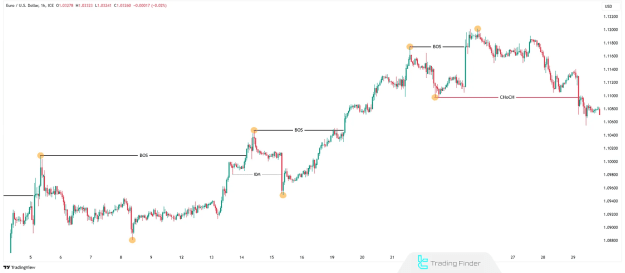
Change of Character (CHoCH) signals the first indication of a potential trend reversal. It is frequently associated with shifts in liquidity and the entry of institutional capital. Traders utilize CHoCH to pinpoint reversal zones and anticipate potential trend shifts.
Market Structure
Market structure describes how price movements form trends within the market. Smart Money traders initially analyze the overall market structure to identify significant entry and exit levels. By evaluating uptrends and downtrends, highs & lows, and price accumulation zones, traders can determine the probable direction of the market.
Break of Structure (BOS)
A Break of Structure (BOS) occurs when the price surpasses a significant high or low, establishing a new direction. This event typically signifies a continuation of the existing trend. Smart Money traders use BOS to confirm trend continuation and enter positions in alignment with the prevailing market trend.
Order Blocks (OBs)
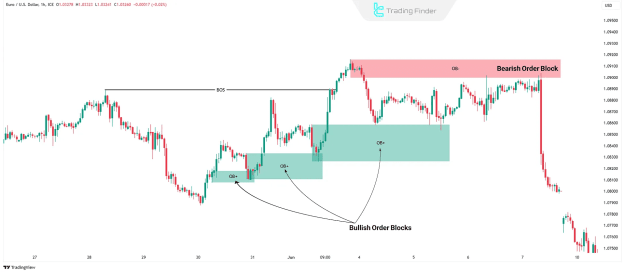
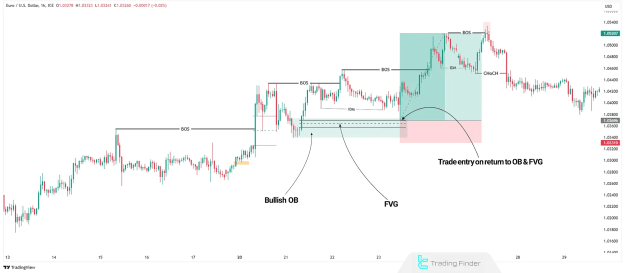
Order Blocks (OBs) are specific price areas where financial institutions place substantial buy or sell orders. These zones frequently serve as critical entry points in Smart Money trading. Traders enter in the direction of institutional order flow from these high-probability areas.
Breaker Blocks (BB)
Breaker blocks form when price breaks through an existing order block and establishes itself in a new direction. These blocks then act as new support and resistance levels. Traders use breaker blocks to identify price reversals following structural shifts.
Fair Value Gaps (FVGs)
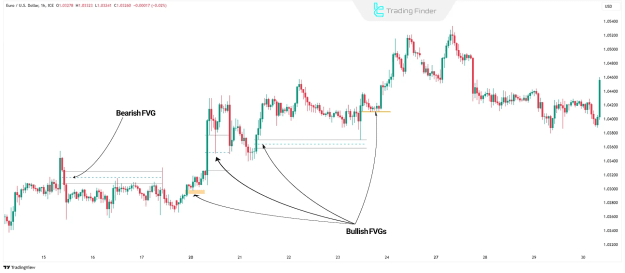
An Fair Value Gap (FVG) represents a rapid price movement from one level to another, leaving an unfilled price gap. This gap is typically caused by large institutional orders. Smart Money traders use FVGs to identify areas where prices may retrace to fill the existing imbalance.
Liquidity Sweep & Liquidity Run (Liquidity Grabs)
Institutions manipulate liquidity by driving prices into areas where retail traders' stop-losses are clustered before initiating their own trades. Smart Money traders wait for this liquidity to be absorbed before entering trades in alignment with institutional traders' orders.
How Does Smart Money Control the Market?
Banks, financial institutions, and investment funds control Smart Money in the Forex market. These entities manipulate and drive the market through various strategies, including:
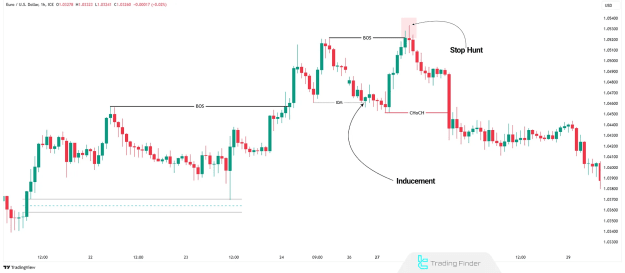
- Inducement: Smart Money traps retail traders into entering positions in the wrong direction to trigger their stop-losses, ensuring sufficient liquidity for institutions to enter their own trades.
- Stop Hunts: Institutions intentionally push prices into stop-loss zones to absorb liquidity, forcing retail traders out of the market before executing their large orders with minimal slippage.
- False Breakouts & Fake Support/Resistance Levels: Smart Money creates false breakouts to deceive traders into entering positions, only to reverse prices in the opposite direction shortly thereafter.
How to Trade Using the Smart Money Concept?
To trade effectively with Smart Money trading concepts in Forex, traders should follow these steps:
- Determine Market Trend: Analyze the overall price structure on higher timeframes (e.g., H1, H4).
- Identify Structural Breaks (BOS & CHoCH): Look for BOS to confirm trend continuation and CHoCH for potential reversals.
- Find Order Blocks: Identify high-probability OBs aligned with the institutional trade flow.
- Evaluate Fair Value Gaps: Spot price imbalances to anticipate possible retracements.
- Analyze Liquidity Grabs: Look for areas with high stop-loss clusters and wait for liquidity to be taken.
- Enter Trade: Once all conditions align, enter with a logical stop-loss and profit target, typically on lower timeframes (e.g., 15M or less).
Differences Between Smart Money and ICT Trading
Both SMC and ICT (Inner Circle Trader) trading styles focus on liquidity and institutional order flow, but they differ in methodology:
- Approach: ICT Trading emphasizes timing, liquidity models, and market maker manipulation, while SMC primarily focuses on Order Blocks (OBs), CHoCH, and BOS.
- Liquidity Analysis: ICT Trading utilizes PD Arrays & Market Maker Models, whereas SMC identifies price movement and liquidity grabs.
- Sessions & Timing: ICT Trading places more emphasis on session liquidity shifts, while SMC gives less weight to specific session timing.
Differences Between Smart Money & Classic Technical Analysis
To understand the distinctions between Smart Money trading in Forex and traditional technical analysis (often referred to as the retail trader approach), a comparison based on market analysis approach, tools used, and entry/exit strategies is essential:
- Market Analysis: Smart Money focuses on liquidity flow and institutional orders, while Traditional Analysis relies on classic indicators.
- Entry/Exit Points: Smart Money identifies entry and exit points through Order Blocks & BOS, whereas Traditional Analysis uses Support & Resistance.
- Data Used: Smart Money utilizes institutional order flow, while Traditional Analysis primarily uses price data & indicators.
- Market Impact: Smart Money concepts are linked to driving major trends, while Traditional Analysis is generally reactive to market moves.
Conclusion
The Smart Money Concept provides a powerful framework for comprehending the institutional liquidity and order flow within financial markets. By focusing on order blocks, BOS, CHoCH, and liquidity grabs, this methodology offers traders a unique perspective on price action.