

Breakaway Gaps in ICT Trading Style: Key Components
Three critical components contribute to the formation of a breakaway gap:
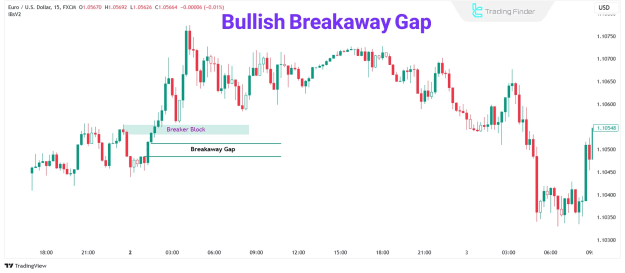
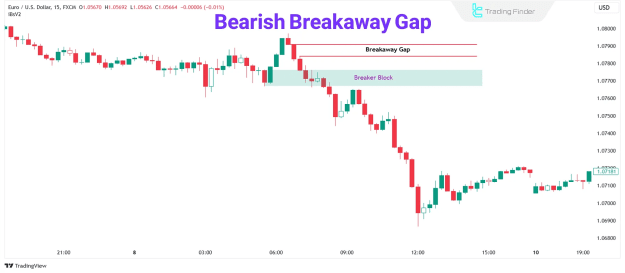
- Breaker Block: This acts as the primary barrier preventing price reversal. A breaker block emerges when the price surpasses a significant high and continues upward. Upon its return, the breaker block serves as the initial obstacle, halting further downward movement.
- Inverse Fair Value Gap: This provides secondary confirmation of the price movement and gap formation. When the price moves upward and breaches a bearish fair value gap, it transforms into a bullish inverse fair value gap.
- Balanced Price Range (BPR): This creates an overlapping area that helps maintain price direction. The overlap between a bearish FVG and a bullish FVG forms the BPR, which actively prevents further downward movement, leaving the remaining BISI (Buy-Side Imbalance Sell-Side Inefficiency) as a breakaway gap.
Differentiating Breakaway Gaps from Regular Fair Value Gaps
The key distinction between Breakaway Gaps and regular FVGs lies in their post-formation behavior. While FVGs typically get filled, Breakaway Gaps signify exceptional momentum that precludes an immediate price return. The importance of a Breakaway Gap is its capacity to confirm price direction and the strength of momentum. When identified with high volume, it signals stronger conviction in the breakout's trajectory.
Types of ICT Breakaway Gaps
ICT Breakaway Gaps are categorized into two primary types:
- Bullish Breakaway Gap (BISI): This forms near a significant high after it has been breached with a strong upward move. This type of gap indicates sustained upward price movement.
- Bearish Breakaway Gap (SIBI): This forms near a significant low after it has been broken with a strong downward move, with the price not expected to return to mitigate the gap.
Market Structure Analysis with Breakaway Gaps
Understanding market structure is paramount for successful ICT Breakaway Gap trading. This analysis can be systematically conducted using various parameters:
- Premium/Discount Arrays (PD Arrays): To identify premium and discount zones:
- Define a price range between high and low points.
- Utilize Fibonacci tools to divide this range into two distinct zones: premium (above 50%) and discount (below 50%).
- To effectively plan trades, search for key elements such as Order Blocks, Fair Value Gaps, and Breaker Blocks within these zones.
- Order Flow Dynamics: When analyzing Order Flow, focus on zones where price exhibits specific behaviors. A trading range is established when both buy-side and sell-side liquidity have been absorbed. Key factors include:
- Formation of Order Blocks.
- Liquidity pools.
- Price equilibrium points.
- Smart money footprints.
- Price Movement Patterns: Specific price movement patterns reveal the quality of a Breakaway Gap. Patterns accompanied by above-average volume are generally more effective. It's crucial to consider that the price tends to maintain its direction after a valid Breakaway Gap, confirming the underlying trend's strength. This is particularly significant when the price moves away from substantial support or resistance levels.
Multi-Time Frame Analysis in ICT Breakaway Gaps
The role of multi-timeframe analysis is crucial in the trading journey with ICT Breakaway Gaps. This approach significantly enhances decision-making by providing a comprehensive market view.
- Higher Time Frames: Gaps observed in higher time frames, such as daily or weekly charts, are inherently more reliable than those in lower time frames. This approach helps maintain an unbiased perspective and mitigates common trading errors.
- Lower Time Frame Confirmation: After establishing a higher time frame bias (e.g., Daily Bias), utilize lower time frames for precise entry timing. Structure your analysis with lower time frame confirmation as follows:
- Identify potential Breakaway Gaps in higher time frames.
- Search for relevant fair value gaps in lower time frames.
- Confirm entry signals with volume analysis.
- Monitor price movement patterns for continuation.
- Time Frame Correlation Techniques: Successful multi-timeframe trading necessitates consistency in time frame selection. Adhere to a chosen combination for at least 30-50 trades before considering adjustments. This approach allows for improved risk-to-reward ratios by leveraging higher time frames for directional bias while executing trades in lower time frames. Correlation also aids in avoiding overnight risks and news events while maximizing profit potential. Pay close attention to volume patterns during time frame correlation, as high trading volume accompanying Breakaway Gaps validates their validity and strength.
Implementation and Risk Management
Successful trading with ICT Breakaway Gaps demands disciplined implementation and a robust risk management approach.
- Entry and Exit Strategies: The most effective entries occur when Breakaway Gaps are unequivocally confirmed through volume and price movement. Exit strategies should adhere to a structured approach based on multiple contracts:
- First target at initial support/resistance levels.
- Second target at major market structure points.
- Final portion for broader market moves.
- Capital Management Guidelines: Adhering to the one-percent rule is critical for safeguarding trading capital. This includes:
- Never risking more than 1-2% of the total trading account on a single trade.
- Calculating position size based on stop-loss distance.
- Adjusting leverage according to market volatility.
- Stop-Loss Placement: Stop-loss strategies vary based on trade context and market conditions. For Breakaway Gap trades, stops are typically placed:
- Above/below the subsequent execution of the gap.
- At the highest/lowest point of the manipulation phase for trend trades.
- Using a 5-10 point range for London session trades. A minimum ratio of 1:2 is ideal for optimal risk-to-reward ratios, enabling profitability even with a low win rate.
Conclusion
ICT Breakaway Gaps are essentially Fair Value Gaps that remain unmitigated after strong price movements. Mastering ICT Breakaway Gaps requires a profound understanding and disciplined execution.