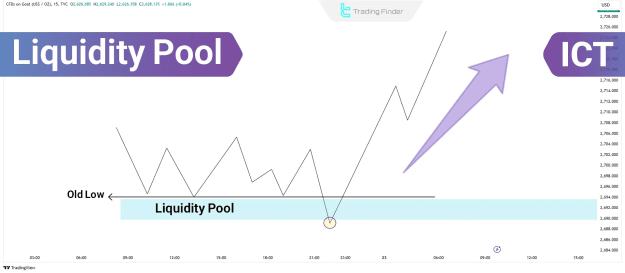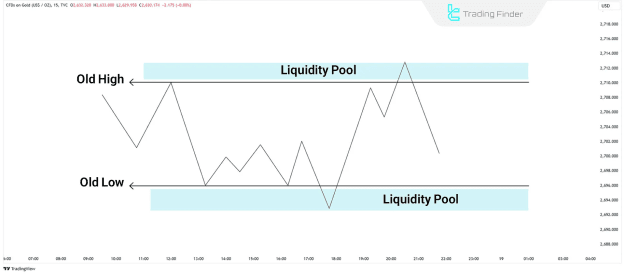


- Above old highs (accumulating Buy Stops).
- Below old lows (accumulating Sell Stops).
Institutional traders (Smart Money) exploit these zones to trigger retail traders’ stop orders, creating favorable entry points—an essential concept in forex education for understanding how market liquidity is manipulated by large participants.
Before diving into Liquidity Pools, it’s crucial to define liquidity in trading:
- Retail traders execute orders at market price.
- Smart Money buys below market price (Discount Zone) and sells above market price (Premium Zone).
Liquidity Pools act as trap zones where institutions absorb retail liquidity before reversing price direction.
Types of ICT Liquidity Pools
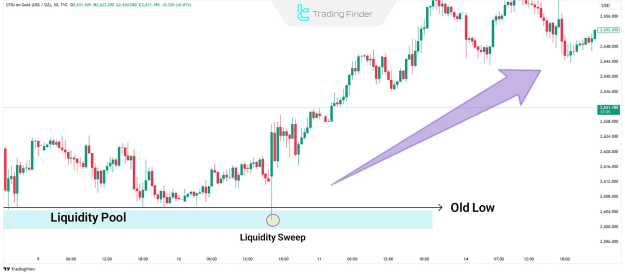
1. Bullish Liquidity Pool (Buy-Side Liquidity)
- Forms below old lows (Sell Stops accumulation).
- Smart Money buys in the Discount Zone, triggering retail sell stops.
- Price then reverses upward, targeting Buy-Side Liquidity above.
How to Trade Bullish Liquidity Pools
- Identify a drop below a recent low.
- Enter long positions as price reclaims the zone.
- Target liquidity above old highs for take-profit.
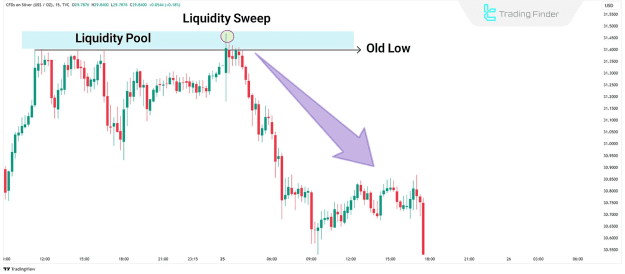
2. Bearish Liquidity Pool (Sell-Side Liquidity)
- Forms above old highs (Buy Stops accumulation).
- Smart Money sells in the Premium Zone, triggering retail buy stops.
- Price reverses downward, targeting Sell-Side Liquidity below.
How to Trade Bearish Liquidity Pools
- Watch for a false breakout above a high.
- Enter short positions upon rejection.
- Target liquidity below old lows for exits.
Key Trading Insights
- No Additional Confirmation Needed: The strategy relies purely on liquidity grabs and order flow.
- High Reliability: Based on market structure and institutional trading behavior.
- Risk Management: Use stop-loss orders beyond recent swing points.
Conclusion
ICT Liquidity Pools provide a powerful framework for identifying institutional traps and high-probability reversals. By mastering:
- Bullish pools (below lows),
- Bearish pools (above highs),
Traders can align with Smart Money and capitalize on retail trader inefficiencies.
For optimal execution, combine liquidity analysis with higher time frame confirmations and disciplined risk management.