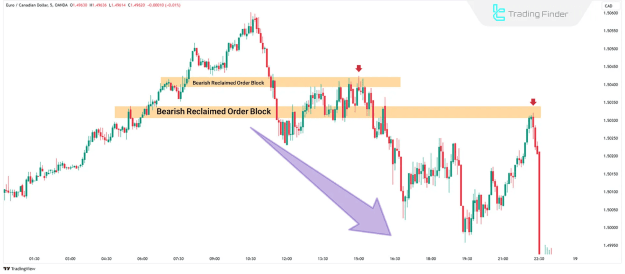


As price returns to a reclaimed zone, it often responds decisively due to prior liquidity accumulation. This makes ROBs powerful tools for traders following Smart Money Concepts (SMC).
Role of Market Makers and Institutional Activity
Market makers and large institutions frequently utilize these zones to accumulate or distribute orders. As price revisits these reclaimed blocks, it often triggers reactions that indicate the intent of Smart Money. These zones:
- Serve as liquidity magnets,
- Act as decision points for directional bias,
- Offer clues about future price movements based on past market structure.
Market Maker Models and Reclaimed Order Blocks
Reclaimed Order Block in Buy Model
In the Market Maker Buy Model, Reclaimed Order Blocks are typically located below the current price action—on the sell side. Here, institutions build long positions as price retraces to the block, accumulating liquidity before initiating an upward expansion.
- These blocks are revalidated through a retracement and serve as bullish launch zones.
- Price displacement confirms institutional engagement.
Reclaimed Order Block in Sell Model
Conversely, in the Market Maker Sell Model, Reclaimed Order Blocks are found on the buy side. As price revisits these zones, institutions capitalize on the retracement to place short positions, setting up a downward move.
- Acts as a bearish rejection point.
- Often follows a short-term liquidity grab before reversal.
Bullish Reclaimed Order Blocks
Key Characteristics
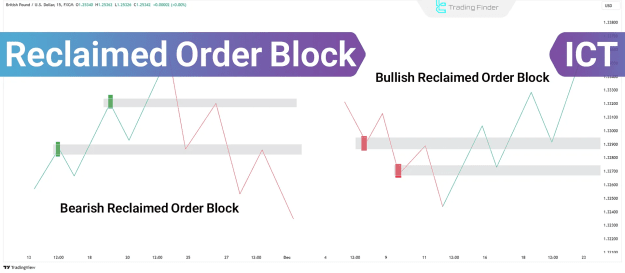
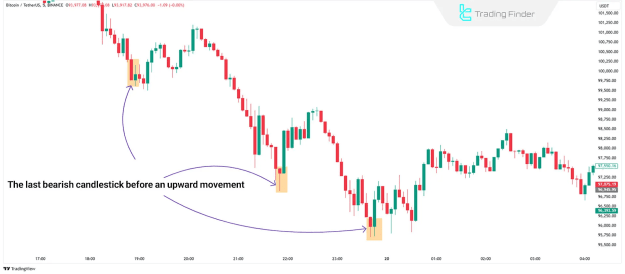
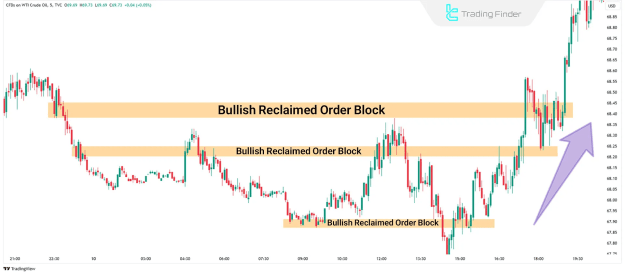
A Bullish Reclaimed Order Block is formed when a bearish candle—once involved in price accumulation—regains importance after a bullish breakout and subsequent retest.
- Appears before a bullish continuation.
- Price briefly dips into the zone, collecting residual liquidity.
- Institutions begin accumulating buy orders in a staggered manner due to volume constraints.
Strategic Application
- Identify the final bearish candle preceding the initial push.
- Monitor for confirmation during price retracement into the block.
- Use it as a support level to enter long positions in line with higher time frame trend.
These zones often coincide with key liquidity pools and institutional re-entry points.
Bearish Reclaimed Order Blocks
Key Characteristics
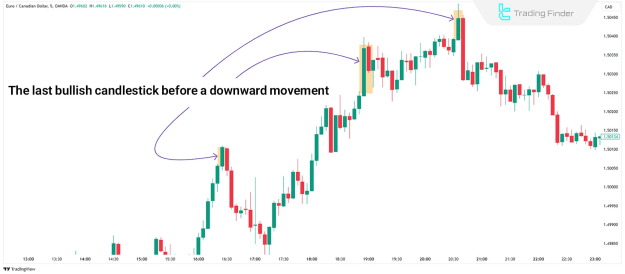
A Bearish Reclaimed Order Block occurs when a prior bullish candle—used for distribution—becomes significant again after a price drop and brief pullback.
- Typically found in downtrending environments.
- Price rises slightly to mitigate the block before continuing lower.
- Institutions gradually establish sell positions on the retrace.
Strategic Application
- Locate the last bullish candle prior to the initial drop.
- Watch for bearish confirmation during retest.
- Utilize the block as a resistance zone for short entries.
These areas reflect institutional intent and act as barriers against bullish retracements.
Practical Insights for Trading Reclaimed Order Blocks
Execution Guidelines
To effectively integrate ROBs into your trading strategy:
- Align entry signals with higher time frame structure.
- Confirm the block’s validity through liquidity sweeps or market structure shifts.
- Utilize risk-managed entries with clear invalidation levels.
Indicators of Validity
- Presence of displacement candles.
- Reaction on retest (wick rejection or engulfing pattern).
- Confluence with Fair Value Gaps (FVGs), Break of Structure (BOS), or Change of Character (CHoCH).
Conclusion
Reclaimed Order Blocks represent a critical component of institutional trading models. By identifying these zones, traders gain insight into areas of prior interest where Smart Money is likely to re-engage.
Whether operating in a bullish or bearish context, these blocks serve as strategic re-entry points, offering a balance between precision and high-probability setups. Their effectiveness increases when combined with time frame alignment, liquidity confirmation, and institutional risk parameters.
Incorporating this concept into a structured trading plan can elevate a trader’s edge by aligning with the behavior of dominant market participants.