

Understanding the Seek & Destroy (S&D) Profile
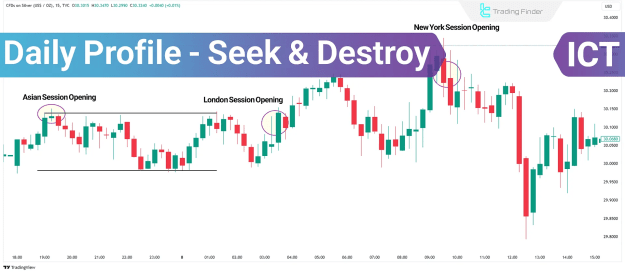
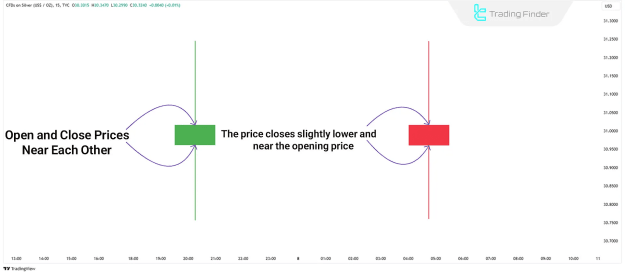
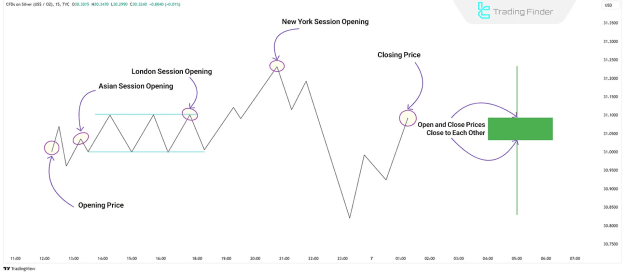
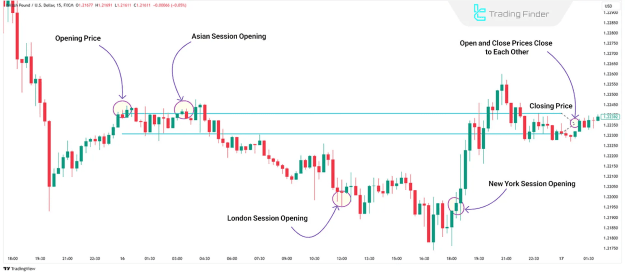
The S&D profile manifests on daily charts as an Indecision Candle, signaling that price action throughout the day lacks clear directional conviction. In such instances, the opening and closing prices remain relatively close, indicative of significant market indecision.
Key Characteristics of the S&D Profile on Lower Timeframes:
- Absence of Initial Direction: At the commencement of the trading day, the market typically exhibits no discernible direction or daily bias.
- Reversal During London Session: The London session often initiates a price movement in one direction, only for that movement to be subsequently reversed.
- Return to Previous Range: Even if price attempts a breakout, it typically reverts to its prior trading range.
Why and When Does the Seek & Destroy (S&D) Profile Occur?
The S&D profile commonly arises under specific market conditions:
- Anticipation of Major Economic News: Markets often remain uncertain prior to critical news releases, such as CPI (Consumer Price Index), FOMC (Federal Open Market Committee) decisions, or NFP (Non-Farm Payrolls) reports.
- Lack of Higher Timeframe Direction: When daily or higher timeframe charts lack clear trends, it can lead to random price movements on lower timeframes.
Identifying the S&D Profile
To effectively detect this profile, traders should meticulously analyze key trading session Kill Zones:
- Asia Session: This session typically establishes the initial price range for the day.
- London Session: In S&D profiles, price frequently sweeps both sides of the Asian range but ultimately fails to establish a sustainable trend.
- New York Session: Price often continues to range and eventually returns to the initial consolidation zone.
Trading the Seek & Destroy (S&D) Profile
When engaging with S&D price action in daily profiles, consider the following strategic steps:
- Focus on Reversion to the Range: Prioritize identifying trade setups where price returns inside the initial range, rather than attempting to trade breakout movements.
- Identify Premium & Discount Levels: Utilize the London session range to delineate equilibrium zones. Seek entry opportunities when price re-enters these zones.
- Utilize Daily Range for Confirmation: Determine the opening and closing prices for the daily range. If price experiences a breakout, anticipate a reversion to the mean.
Risks Associated with Trading the Seek & Destroy (S&D) Profile
Trading this profile carries inherent risks:
- Choppy Price Action: The S&D profile frequently results in aimless, choppy price action, thereby increasing the likelihood of failed trades.
- Reduced Profitability: The market's tendency to range within this profile generally diminishes the probability of securing highly profitable setups.
- Decreased New York Session Volatility: If the London session forms a significant range, the probability of a strong, directional move during the New York session often decreases.
Conclusion
The Seek & Destroy (S&D) Profile represents a complex market behavior within ICT trading, fundamentally signifying uncertainty and price indecision. Due to the pervasive lack of clear trend direction, traders are strongly advised to avoid high-risk trades. Engaging in such conditions can lead to random price movements that are prone to triggering stop losses and accumulating unnecessary losses.