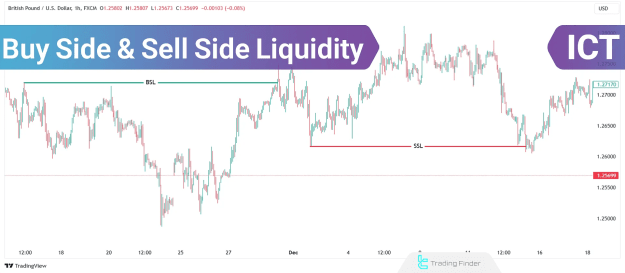


The Essence of Buy Side and Sell Side Liquidity (ICT Style)
Grasping these concepts empowers traders to pinpoint areas where pending orders and stop losses converge. This understanding facilitates a more accurate assessment of market bias through comprehensive liquidity sweep analysis.
What Defines BSL and SSL?
There are two primary categories of liquidity zones, and their comprehension is vital for analyzing prospective price trends.
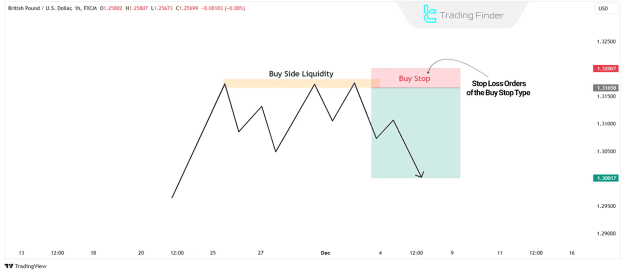
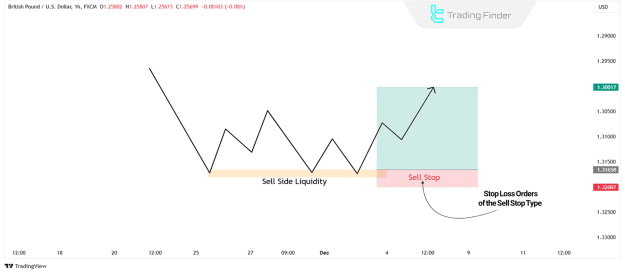
Important Note: A stop loss for a Buy position functions as a Sell order, and conversely, a stop loss for a Sell position operates as a Buy order.
Buy Side Liquidity
Buy Side Liquidity refers to the aggregate volume of pending orders, predominantly Buy Stops, strategically placed by retail traders to safeguard their Sell positions. These orders are typically positioned above crucial price levels, such as previous highs or equal highs (EQH).
Sell Side Liquidity
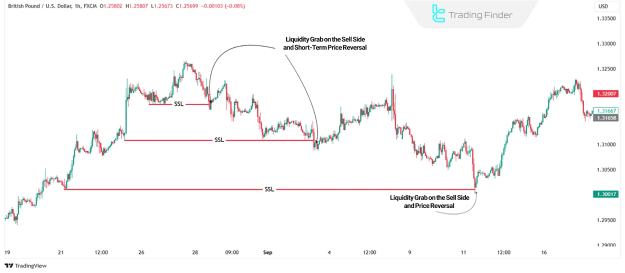
Sell Side Liquidity (SSL) signifies the accumulation of Sell orders, commonly set as Sell Stops beneath critical price levels. Retail traders generally establish these orders below previous lows or equal lows (EQL) to protect their Buy positions.
Strategic Placement of Buy Side and Sell Side Liquidity
As previously noted, traders position Buy Stop or Sell Stop orders in predictable, key areas to shield their trades. These significant zones include:
- Previous swing highs/lows: These are pivotal points on a price chart where price reversals have occurred historically.
- Daily or weekly highs/lows: These timeframes are critical as numerous traders utilize them for setting their stop losses.
- Equal highs or equal lows: When multiple highs or lows converge at the same price level, a concentrated cluster of stop losses is formed.
The Mechanics of Buy Side and Sell Side Liquidity Grabs
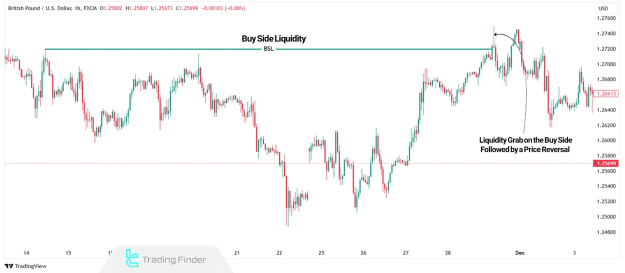
A liquidity sweep denotes a deliberate maneuver by institutional traders designed to trigger pending orders and stop losses. When the market approaches BSL, financial institutions may push the price marginally above resistance levels.
This action activates the stop losses of retail traders, thereby providing liquidity for institutional orders. The typical outcome of such a liquidity grab is an immediate bearish reversal in the market.
Conversely, during a downtrend, a comparable event unfolds when the price dips below a significant support level (SSL), triggering retail traders' stop losses. This often leads to a sharp, bullish reversal in the market.
Integrating BSL and SSL into Trading Strategies
Liquidity plays an indispensable role in dictating the direction of price movement. Effective methods for leveraging Buy Side Liquidity and Sell Side Liquidity include:
- Price inherently strives for balance or liquidity absorption.
- Price movement between P/D arrays is fundamentally driven by this pursuit, making the accurate marking of these zones essential.
- Identifying high-quality trade setups necessitates a concurrent analysis of market structure alongside Order Blocks and premium/discount zones on higher timeframes.
- Daily timeframe liquidity is frequently concentrated at the Previous Week’s High/Low (PWH/PWL), the Previous Day’s High/Low (PDH/PDL), or the highs/lows of the Asian, London, and New York sessions.
- Equal highs and equal lows serve as high-liquidity areas, often targeted by institutions to capture pending orders.
Conclusion
Buy Side and Sell Side Liquidity fundamentally refer to clusters of stop losses strategically placed either above highs or below lows. Retail traders are particularly susceptible to these market traps, especially when their stop losses are set at predictable levels such as previous highs/lows, equal highs/lows (EQH/EQL), session highs/lows, and daily/weekly highs/lows.