



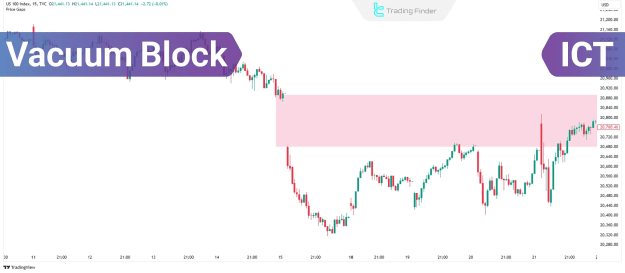
Vacuum Blocks, also known as Liquidity Gaps, represent price discrepancies that emerge during periods of heightened market volatility. These concepts are fundamental in forex education, as they often stem from significant economic news releases, geopolitical developments, supply and demand imbalances, or the commencement of new trading sessions.
Vacuum Block (ICT) indicator
Vacuum Block (ICT) indicator MT4
Vacuum Block (ICT) indicator MT5
What is a Vacuum Block?
A Vacuum Block is a discernable gap in price action that arises from major economic events (e.g., Federal Open Market Committee (FOMC) meetings, Non-Farm Payroll (NFP) reports), the opening of the market, or the initiation of a new trading session.
Since no trades occur within these gaps, they are characterized as liquidity voids. Price typically demonstrates a tendency to return and fill this gap before resuming its initial directional movement.
Formation of a Bullish Vacuum Block
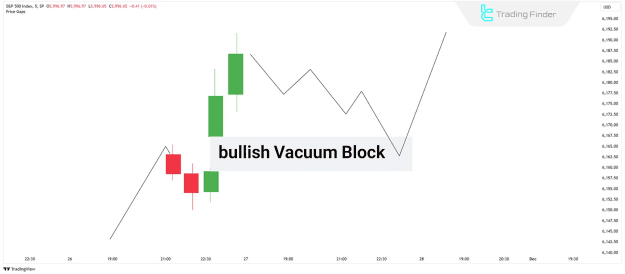
A Bullish Vacuum Block forms when price gaps upward above the prevailing market level, thereby creating a price void. This scenario signifies robust bullish momentum but concurrently indicates a liquidity void that price is likely to revisit. Price frequently gravitates back to this area to fill the liquidity gap prior to continuing its ascent.
How to Trade a Bullish Vacuum Block?
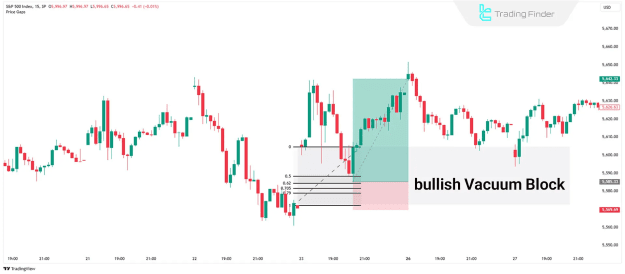
To effectively trade a Bullish Vacuum Block, it is crucial to first analyze the underlying cause and potential impact of the event that precipitated the price gap. If the event carries a long-term influence, it is advisable to await the price's return to the vacuum block before seeking definitive trade confirmations.
Once price retraces to the gap, traders should diligently look for bullish confirmation signals. These may include a Market Structure Shift (MSS) observed on lower timeframes or confluence with Optimal Trade Entry (OTE) levels.
Following confirmation, a buy trade can be initiated, with the stop-loss placed below the lowest point of the vacuum block to manage risk.
Formation of a Bearish Vacuum Block
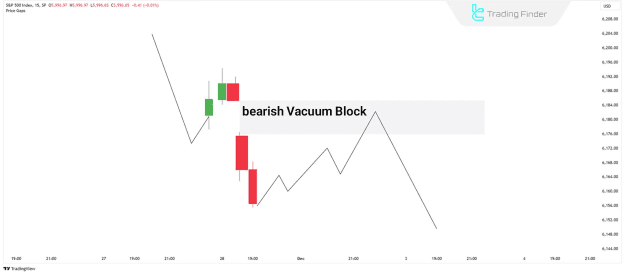
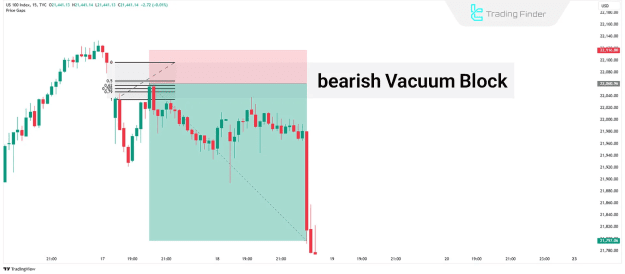
A Bearish Vacuum Block forms when price gaps downward below the current market level, resulting in a liquidity void. This phenomenon often occurs in response to significant economic or geopolitical events, leading to a sharp decline in asset prices.
A bearish vacuum block indicates strong bearish momentum, yet price tends to retest the gap before proceeding with its downward trajectory.
How to Trade a Bearish Vacuum Block?
To trade a Bearish Vacuum Block, the initial step involves identifying the cause and assessing the significance of the price gap. If the event is expected to have a lasting impact, patience is required as price is likely to return to the liquidity void before valid trade confirmations emerge.
Upon price retracing to the vacuum block, traders should seek bearish confirmations. These can manifest as a Market Structure Shift (MSS) on lower timeframes or a reaction to Optimal Trade Entry (OTE) levels.
After receiving confirmation, a sell trade can be entered, with the stop-loss positioned above the highest point of the vacuum block.
Which Assets Experience Liquidity Voids More Frequently?
Vacuum Blocks are commonly observed in assets that exhibit sensitivity to economic news and macroeconomic events. These typically include:
Vacuum Block (ICT) indicator
Vacuum Block (ICT) indicator MT4
Vacuum Block (ICT) indicator MT5
What is a Vacuum Block?
A Vacuum Block is a discernable gap in price action that arises from major economic events (e.g., Federal Open Market Committee (FOMC) meetings, Non-Farm Payroll (NFP) reports), the opening of the market, or the initiation of a new trading session.
Since no trades occur within these gaps, they are characterized as liquidity voids. Price typically demonstrates a tendency to return and fill this gap before resuming its initial directional movement.
Formation of a Bullish Vacuum Block
A Bullish Vacuum Block forms when price gaps upward above the prevailing market level, thereby creating a price void. This scenario signifies robust bullish momentum but concurrently indicates a liquidity void that price is likely to revisit. Price frequently gravitates back to this area to fill the liquidity gap prior to continuing its ascent.
How to Trade a Bullish Vacuum Block?
To effectively trade a Bullish Vacuum Block, it is crucial to first analyze the underlying cause and potential impact of the event that precipitated the price gap. If the event carries a long-term influence, it is advisable to await the price's return to the vacuum block before seeking definitive trade confirmations.
Once price retraces to the gap, traders should diligently look for bullish confirmation signals. These may include a Market Structure Shift (MSS) observed on lower timeframes or confluence with Optimal Trade Entry (OTE) levels.
Following confirmation, a buy trade can be initiated, with the stop-loss placed below the lowest point of the vacuum block to manage risk.
Formation of a Bearish Vacuum Block
A Bearish Vacuum Block forms when price gaps downward below the current market level, resulting in a liquidity void. This phenomenon often occurs in response to significant economic or geopolitical events, leading to a sharp decline in asset prices.
A bearish vacuum block indicates strong bearish momentum, yet price tends to retest the gap before proceeding with its downward trajectory.
How to Trade a Bearish Vacuum Block?
To trade a Bearish Vacuum Block, the initial step involves identifying the cause and assessing the significance of the price gap. If the event is expected to have a lasting impact, patience is required as price is likely to return to the liquidity void before valid trade confirmations emerge.
Upon price retracing to the vacuum block, traders should seek bearish confirmations. These can manifest as a Market Structure Shift (MSS) on lower timeframes or a reaction to Optimal Trade Entry (OTE) levels.
After receiving confirmation, a sell trade can be entered, with the stop-loss positioned above the highest point of the vacuum block.
Which Assets Experience Liquidity Voids More Frequently?
Vacuum Blocks are commonly observed in assets that exhibit sensitivity to economic news and macroeconomic events. These typically include:
- Major forex pairs (e.g., EUR/USD, GBP/USD)
- Stock indices (e.g., S&P 500, NASDAQ)
- Commodities (e.g., gold, crude oil)
- Cryptocurrencies, renowned for their high volatility
Does Price Always Fill a Vacuum Block?
It is important to note that price does not always fully fill a vacuum block.
- In some instances, only a portion of the gap is filled before the prevailing trend resumes.
- Conversely, there are times when price completely fills the gap prior to continuing in the same direction.
- There is no definitive guarantee that a vacuum block will be entirely filled.
Conclusion
A Vacuum Block (Liquidity Gap) is fundamentally a price void generated by high volatility or significant economic events. These gaps often demonstrate a propensity to be filled, thereby rendering them valuable tools for identifying key trading levels and implementing effective risk management strategies.
Attached Image(s) (click to enlarge)
Attached File(s)
