

What Are Premium and Discount Zones?
Within the ICT (Inner Circle Trader) methodology, Premium and Discount Zones define specific price areas:
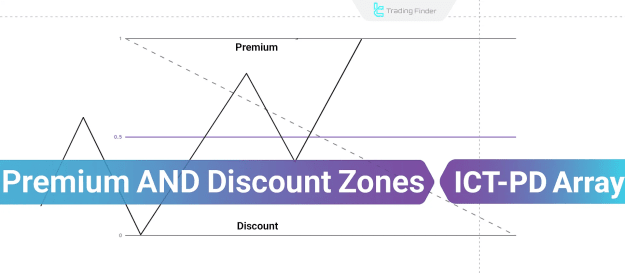
- Discount Zones: These represent the lower half of a given price range. They are primarily utilized for identifying potential buying opportunities and for setting take-profit targets for selling positions.
- Premium Zones: Conversely, these encompass the upper half of a price range. They are used to identify potential selling opportunities and to establish take-profit targets for buying positions.
Benefits of Using the PD Array
Implementing the PD Array significantly enhances market analysis and refines trading decisions. Key advantages include:
- Identifying Buy and Sell Areas: By segmenting the market into distinct premium and discount zones, the PD Array clearly highlights optimal price regions for both purchases and sales.
- Better Trade Timing: This strategy improves the precision of trade entries by emphasizing buying within discount zones during uptrends and selling within premium zones during downtrends.
- Increased Precision: The PD Array integrates various ICT tools, leading to enhanced accuracy in pinpointing ideal entry and exit points.
- High-Probability Trades: It enables traders to engage in high-probability trades while effectively mitigating exposure to high-risk positions.
Types of PD Array in ICT
The ICT PD Array incorporates a suite of essential tools designed to identify optimal entry and exit points, providing traders with a deeper comprehension of price dynamics.
PD Array Tools
- ICT Fair Value Gap (FVG): Identifies imbalances in price action, indicating areas where price may seek to return.
- ICT Inversion Fair Value Gap: Highlights specific order blocks where a prior FVG has been violated, often signaling a reversal.
- ICT Order Block: Focuses on specific price areas where significant institutional orders were placed, often leading to strong price reactions.
- ICT Breaker Block: Identifies recovery zones after a significant price break, indicating potential support or resistance.
- ICT Mitigation Block: Marks fair value gaps that have been revisited and reversed, suggesting a shift in market sentiment.
- ICT Unicorn: Refers to unique, often complex, analytical patterns that provide high-probability trading setups.
- ICT NWOG (New Week Opening Gap): Analyzes gaps formed at the open of a new trading week.
- ICT NDOG (New Day Opening Gap): Examines gaps formed at the open of a new trading day.
How to Identify PD Array Zones?
To delineate Premium and Discount zones, the Fibonacci retracement tool is employed with specific settings:
- 1 (Start): Represents the beginning of the price range.
- 0.5 (Equilibrium): Denotes the 50% midpoint of the range.
- 0 (End): Marks the conclusion of the price range.
Steps
- Draw the Fibonacci tool from a recent significant price high to a significant price low (for a bearish range) or from a low to a high (for a bullish range).
- The 0.5 level on the Fibonacci retracement tool signifies the equilibrium point, representing 50% of the price range.
- The area located above the 0.5 level is designated as the Premium Zone, indicating relatively expensive prices.
- The area situated below the 0.5 level is identified as the Discount Zone, representing relatively cheap prices.
How to Use PD Array?
Utilizing the PD Array (Premium-Discount Array) involves distinct approaches for bullish and bearish market scenarios.
Bullish Scenario
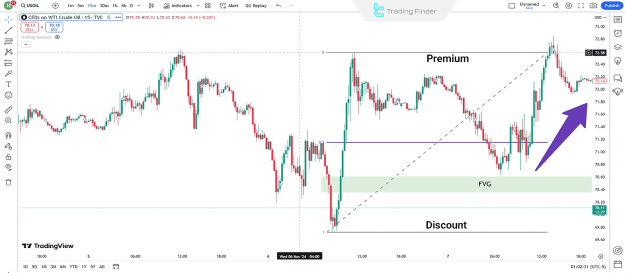
If the price transitions into an upward market structure and is situated within the Discount Zone, it signals an opportune moment to initiate a buy trade.
Bearish Scenario
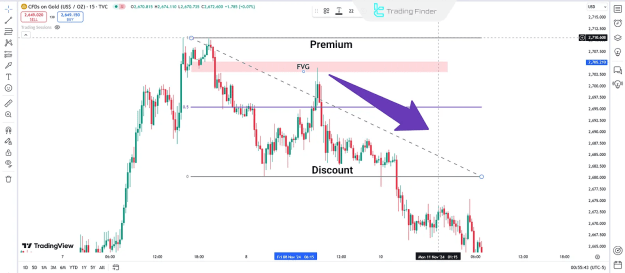
Conversely, if the price shifts into a downward market structure and is located within the Premium Zone, it indicates a favorable opportunity to execute a sell trade.
Best Timeframes for Premium and Discount Zones in ICT
The efficacy of the PD Array is optimized by applying it across multiple timeframes:
- Daily Timeframe: Ideal for identifying the overarching market direction and trend.
- 15-Minute and 5-Minute Timeframes: Essential for pinpointing precise entry and exit points for trades.
Which Markets Are Suitable for PD Array?
While originally developed for major indices such as NASDAQ (NQ Futures) and S&P 500, where it has consistently demonstrated high accuracy and efficiency, the PD Array strategy has been successfully adapted to various other financial markets, including:
- Forex: Proven effective in major currency pairs like GBP/USD and EUR/USD.
- Precious Metals: Exhibited reliability in commodity markets such as Gold (XAU/USD).
Buy Trades in PD Array
To execute buy trades using the PD Array:
- Utilize higher timeframes (e.g., daily, 4-hour charts) to ascertain the prevailing market trend.
- If the overall trend is bullish and the price has entered the Discount Zone, confirm the uptrend with additional ICT tools and initiate buy trades.
Premium and Discount Zones in Buy Positions
Example of Bullish Trading with Premium and Discount Zones
Sell Trades in PD Array
To execute sell trades using the PD Array:
- Employ higher timeframes (e.g., daily, 4-hour charts) to determine the dominant market trend.
- If the overall trend is bearish and the price has ascended into the Premium Zone, confirm the downtrend using other ICT tools and commence sell trades.
Premium and Discount Zones in Sell Positions
Example of Bearish Trading with Premium and Discount Zones
Advanced Tips for Using PD Array
To maximize the effectiveness of the PD Array, consider these advanced strategies:
- Multi-Timeframe Analysis: Consistently align observations across multiple timeframes to confirm signals and increase conviction.
- Market Structure Confirmation: Always ensure that PD Array signals are congruent with the prevailing market trend and structure.
- Tool Confluence: Combine the PD Array with other ICT tools to build stronger trading biases and improve the probability of successful outcomes.
- Trend Identification: Accurately analyze and confirm the market direction before executing any trades based on PD Array signals.
Conclusion
The ICT PD Array represents a robust and structured methodology for analyzing financial markets and executing trades. By integrating advanced analytical tools and contemporary techniques, traders can achieve heightened precision in market analysis, manage risk more effectively, and ultimately strive for consistent success in their trading endeavors.