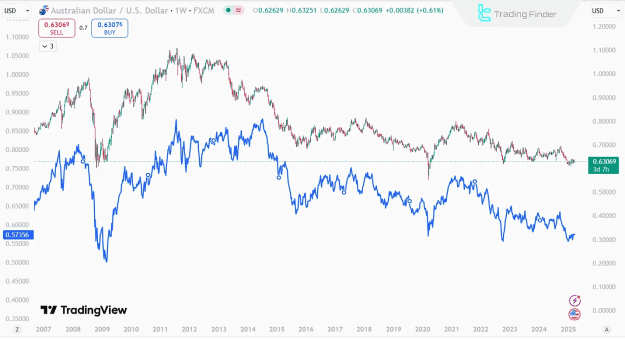


Tools to Identify Breakouts:
Why Is Currency Pair Correlation Important in Trading?
Understanding currency pair correlations empowers traders to implement smart hedging, precise risk control, and validate technical breakouts. Here are five key reasons why monitoring currency correlations is indispensable:
1. Eliminating Counter Trades
By identifying pairs with strong negative correlations, traders can prevent simultaneous trades that effectively cancel each other out. Placing opposing trades on negatively correlated pairs can neutralize potential profits or exacerbate losses unnecessarily.
For instance, opening a long AUD/USD and a short NZD/USD simultaneously can effectively neutralize the overall impact on your portfolio, as these pairs often move in similar directions against the USD. Recognizing this correlation helps traders avoid redundant or conflicting positions.
2. Profiting from Temporary Divergences
Occasionally, highly correlated currency pairs may diverge due to significant political, geopolitical, or economic events. These temporary divergences present unique opportunities for astute traders to profit from the anticipated reversion to correlation. By entering positions aligned with the expected price reversal, traders can capitalize on the market's natural tendency to correct itself.
Consider a scenario where the EUR/USD weakens due to political uncertainty in Germany, while the GBP/USD remains stable or strengthens. Post-election, the EUR/USD is likely to revert to its historical correlation with the GBP/USD. A trader could strategically go long in EUR/USD, anticipating this return to equilibrium.
3. Hedging Positions
A deep understanding of asset and currency pair correlations is fundamental for effective hedging and robust risk control. Traders can strategically use correlated assets to offset potential losses from unexpected market shifts.
For example, during periods of heightened market risk aversion due to geopolitical tensions, a trader might open long positions on gold and a safe-haven currency like the Swiss Franc. Simultaneously, recognizing the unpredictable nature of geopolitical events, the trader might also enter a long position in a "Risk On" asset. This dual approach provides a balanced hedge:
- If the geopolitical conflict persists, the "Risk On" position may hit its stop-loss, but the gains from the gold and Swiss Franc positions would largely offset this loss.
- Conversely, if the geopolitical risk suddenly dissipates, the gold and Swiss Franc positions might hit their stop-loss, but the "Risk On" position would likely reach its profit target, mitigating a significant portion of the losses.
4. Testing Breakouts and Technical Confirmations
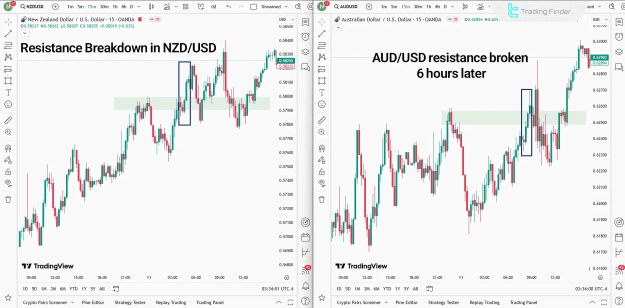
Comparing correlated pairs is an invaluable method for validating breakouts at key support and resistance levels. When one pair breaks a significant technical level, observing the behavior of its correlated counterparts can provide crucial confirmation or signal a false breakout.
For example, the NZD/USD currency pair typically exhibits a positive correlation with AUD/USD and a strong negative correlation with USD/CAD and USD/CHF. If the NZD/USD breaks a significant technical support level, two scenarios can unfold:
- Confirmed Breakout: If other correlated pairs (e.g., AUD/USD, USD/CAD) also break their respective key levels, this provides strong confirmation of the trend and increases the likelihood of a genuine breakout.
- False Breakout: If other correlated pairs do not weaken against the USD, it suggests that NZD's weakness might be attributable to isolated local economic or political factors, indicating a false breakout in NZD/USD.
This cross-confirmation strategy can be critical for avoiding erroneous trades.
5. Diversifying Risk
Risk diversification is another significant benefit of understanding currency pair correlations. Instead of concentrating risk in a single position, traders can distribute it across highly correlated currency pairs.
For instance, if a trader has a bearish outlook on the US Dollar and intends to open a short position on EUR/USD with a 0.5% risk, they can choose to short EUR/USD with a 0.25% risk and simultaneously short GBP/USD with the remaining 0.25% risk. This approach means that if an unforeseen event adversely affects the Euro specifically, only 0.25% of the account will be immediately impacted, rather than the full 0.5%.
Conclusion
Currency correlation is an indispensable tool for Forex traders, enabling them to mitigate unwanted losses, avoid unnecessary trades, and implement sophisticated risk management techniques. By strategically leveraging correlations to eliminate counter trades, capitalize on temporary divergences, and employ smart hedging strategies, traders can significantly enhance their profitability and protect their capital. Understanding how to distribute trading risk across positively correlated currency pairs further solidifies a robust trading approach.