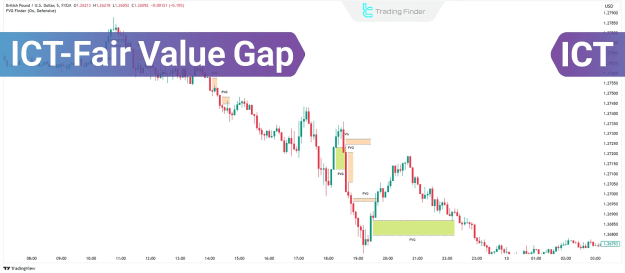


What Is a Fair Value Gap (FVG)?
A Fair Value Gap represents a temporary imbalance between buyers and sellers. It occurs when the market skips over price levels within a three-candle sequence, creating an “inefficiency” that often gets revisited.
How It Forms:
- The middle candle of the pattern shows strong momentum, usually with a large body.
- The first and third candles leave a gap—price does not retrace the full range between their highs and lows.
- This skipped area signals a lack of fair price discovery, usually due to aggressive buying or selling.
Over time, price often revisits this zone to “fill” the gap and rebalance the market before continuing in its original direction.
Types of Fair Value Gaps
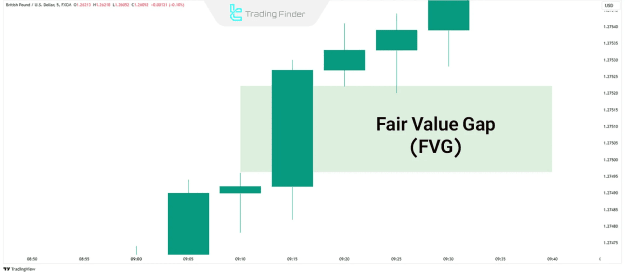
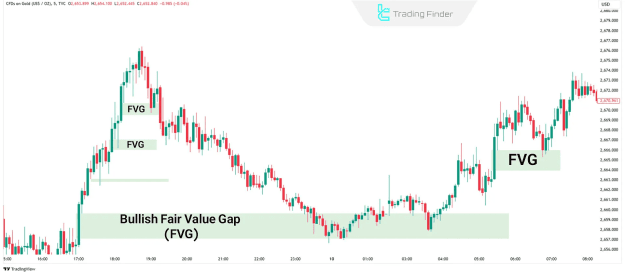
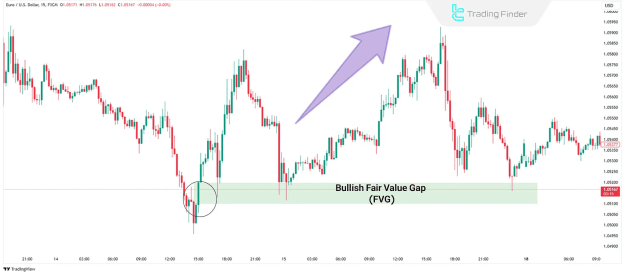
Bullish Fair Value Gap
Occurs during an uptrend and signals future buying opportunities.
Formation:
- The second candle is strongly bullish.
- A visible gap forms between the high of the first candle and the low of the third.
Characteristics:
- Indicates strong buy-side pressure.
- Appears in discount zones, offering value-buy opportunities.
- Price often pulls back to this level before continuing higher.
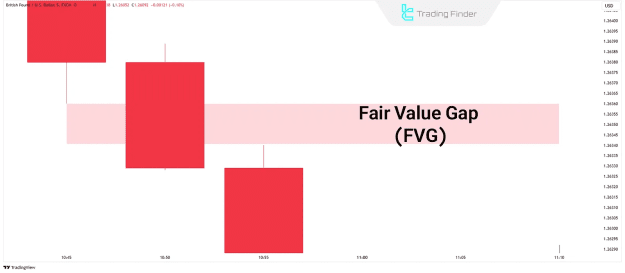
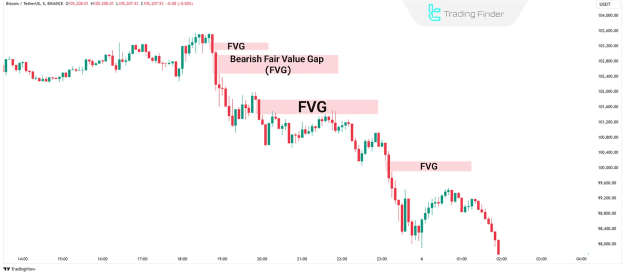
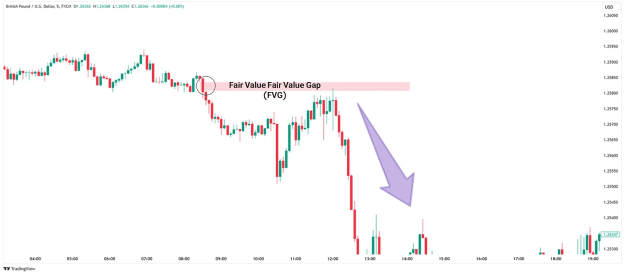
Bearish Fair Value Gap
Forms during a downtrend and highlights potential sell zones.
Formation:
- The second candle is strongly bearish.
- A gap forms between the low of the first candle and the high of the third.
Characteristics:
- Signals aggressive sell-side activity.
- Common in premium zones, where prices are overextended.
- Traders often look to short the market once the price revisits this area.
Why Fair Value Gaps Matter
FVGs play a vital role in identifying institutional trading behavior. They show where liquidity was left behind, which often becomes a magnet for future price action.
Key Benefits:
- Provide clear trade entry points.
- Help forecast price reversals or continuations.
- Fit seamlessly into price action and ICT (Inner Circle Trader) strategies.
ICT Approach to Trading FVGs: Step-by-Step
1. Identify the Market Structure
- Uptrend: Look for higher highs and higher lows.
- Downtrend: Watch for lower highs and lower lows.
2. Mark Premium & Discount Zones
- In a downtrend, FVGs in premium zones (above the equilibrium) offer ideal sell opportunities.
- In an uptrend, FVGs in discount zones (below equilibrium) are optimal for buying.
3. Spot the Dominant Candle
- Find a candle with a large real body and minimal wicks.
- This represents the aggressive move that causes the imbalance.
4. Confirm the FVG Setup
- Ensure that the bodies of the first and third candles do not overlap the second.
- This validates a true price gap.
5. Define the FVG Zone
- Bullish setup: Gap lies between the high of the first and low of the third candle.
- Bearish setup: Gap lies between the low of the first and high of the third candle.
6. Execute the Trade
- Bullish trade: Wait for a return to the FVG in a discount zone, look for bullish confirmation, and enter a long position.
- Bearish trade: Wait for price to revisit the FVG in a premium zone, watch for bearish confirmation, and enter a short position.
Choosing the Right Timeframes
To trade FVGs effectively, multi-timeframe analysis is key:
- Higher Timeframes (4H, Daily):
- Identify overall market direction.
- Spot major FVG zones.
- Lower Timeframes (5-min, 15-min):
- Find precise entry and exit points within the larger structure.
- Improve risk-to-reward ratio.
Best Markets for Fair Value Gap Strategy
Although FVG analysis originated in U.S. stock indices like the Nasdaq and S&P 500, it has proven highly effective in the forex market and beyond.
Common Markets:
- Major forex pairs (EUR/USD, GBP/USD, etc.)
- Commodities (Gold, Oil)
- Cryptocurrencies (Bitcoin, Ethereum)
- Equity indices
Its adaptability makes FVG trading a cornerstone of modern technical strategies.
Final Thoughts
Fair Value Gaps offer a window into institutional price movement, revealing hidden liquidity zones and imbalance areas. Mastering this concept, especially through ICT trading frameworks, gives traders a strategic edge in spotting powerful setups.
By combining FVGs with strong market structure and confirmation signals, traders can greatly improve their precision, timing, and profitability in any market condition.