

ICT Optimal Trade Entry (OTE) Strategy: An Overview
The ICT (Inner Circle Trader) Optimal Trade Entry (OTE) strategy is designed to empower traders with the ability to execute entries with exceptional precision, particularly during corrective price movements within an established primary trend.
What Is OTE (Optimal Trade Entry)?
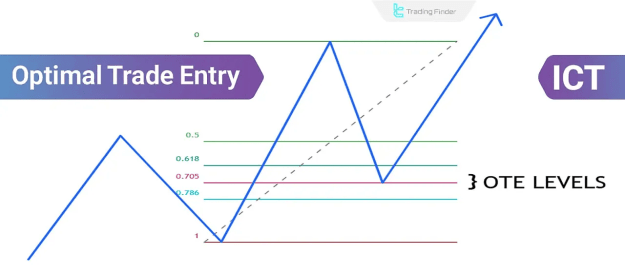
OTE refers to a highly calculated trading setup aimed at facilitating accurate entries during price pullbacks or retracements.
OTE in ICT Style
Within the framework of ICT methodology, OTE leverages the Fibonacci tool to discern optimal entry points. This approach is often applied within specific time windows during the trading day, ensuring that entries are primarily aligned with corrective phases of the prevailing trend.
OTE Strategy in Action
The OTE strategy operates by employing key Fibonacci levels to pinpoint potential price reversal zones and, consequently, optimal entry points.
Required Tools for OTE Setup
Successful implementation of the OTE setup necessitates the utilization of several critical concepts and analytical tools:
- Fibonacci Tool: This fundamental tool is essential for identifying crucial retracement and extension levels.
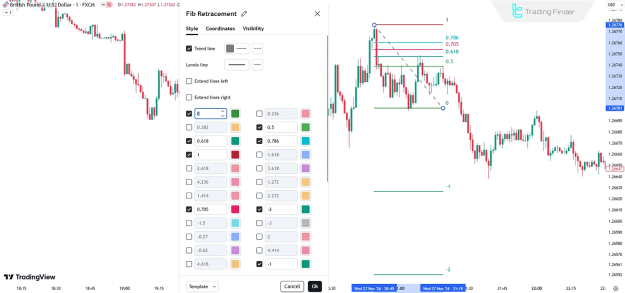
- Fibonacci Tool Settings: Proper configuration of the Fibonacci tool is paramount for effective OTE strategy application.
- For Entry Zone:
- 62% (0.618)
- 70.5% (0.705)
- 79% (0.79)
- For Stop Loss:
- (1) 100%
- For Take Profit:
- 0
- -1
- -1.5
- -2
- For Entry Zone:
- Fibonacci Tool Settings: Proper configuration of the Fibonacci tool is paramount for effective OTE strategy application.
- Order Blocks: These are critical price areas where significant prior price movements (e.g., within PD Arrays) suggest a high probability of price reaction.
- Liquidity Zones: These zones, particularly in Forex, represent areas where stop-loss orders or pending orders are concentrated, making them targets for price movements as liquidity is "collected."
- Higher and Lower Timeframe Analysis:
- Higher Timeframes (e.g., Daily or 4-Hour): Employed to ascertain the overarching market trend and structure.
- Lower Timeframes (e.g., 15-Minute or 5-Minute): Used to identify precise entry triggers and refine trade execution.
- Specific Timing: The OTE strategy demonstrates optimal performance when trades are initiated during predefined time windows, often referred to as ICT Kill Zones.
Steps to Execute the OTE Setup
To effectively utilize the OTE setup and minimize potential errors, adherence to the following structured guidelines is highly recommended:
- Analyze the Trend in Higher Timeframes:
- Identify the prevailing market trend.
- Assess market structure by examining key highs and lows.
- In an uptrend, seek pullback zones for long entries.
- In a downtrend, look for pullback zones for short entries.
- Identify the Key Order Block:
- Locate the Order Block from which the price initiated a significant move.
- For an uptrend, identify the last bearish candle preceding a strong bullish move.
- For a downtrend, identify the last bullish candle preceding a strong bearish move.
- Apply the Fibonacci Tool:
- Draw Fibonacci levels on the most recent significant price swing (swing low to swing high for an uptrend, or swing high to swing low for a downtrend).
- The optimal entry zone typically lies within the 62% to 79% retracement levels.
- Confirm Liquidity Grab:
- Verify that the price has collected liquidity before reaching the OTE zone.
- This often involves a sweep of a previous high or low, targeting retail traders' stop-loss levels.
- Mark the Specific Time Window:
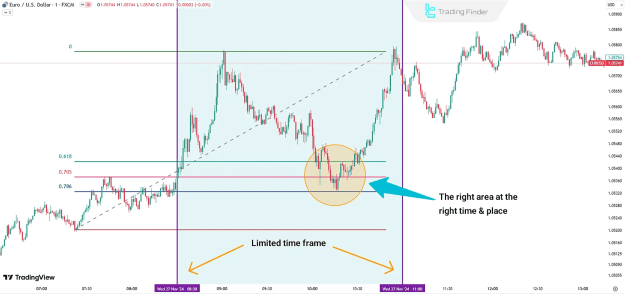
- The most favorable time for OTE setup is generally between 8:30 AM and 11:00 AM New York time. Adjust this timeframe to your local timezone using a converter.
- Identify Lower Timeframe Triggers:
- Transition to a lower timeframe (e.g., 5-minute or 15-minute).
- Look for a Market Structure Break (or Break of Structure).
- Confirm with a specific confirmation candle from the Order Block.
- Observe a retest of the OTE zone.
Managing the Trade in OTE Setup
Trade management within the OTE setup is streamlined because all crucial components—entry, stop-loss, and take-profit levels—are derived directly from the Fibonacci settings.
Trade Components
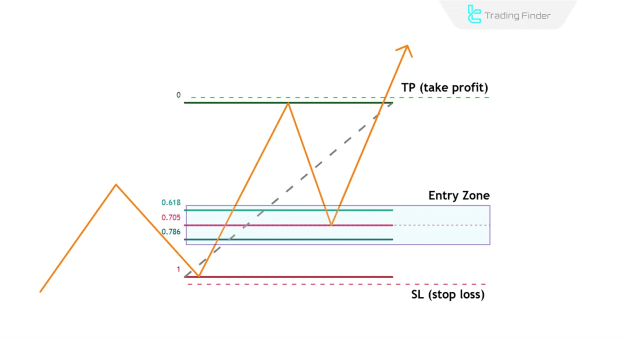
The key components of a trade using the OTE strategy include the entry zone, take-profit levels, and stop-loss placement.
Stop Loss Placement
- For a bearish setup: Position the stop loss above the 100% Fibonacci level.
- For a bullish setup: Place the stop loss below the 100% Fibonacci level.
Take Profit Targets
Potential take-profit targets include:
- The previous high or low (opposite to the direction of entry).
- Specific Fibonacci extension levels (e.g., -1 or -2).
Risk Management
- Always adhere to a fixed percentage of capital risked per trade (e.g., 1%).
- Employing an appropriate Risk/Reward Ratio is crucial for optimizing trade outcomes.
Note: The One Shot One Kill Indicator from TradingFinder is an advanced tool that integrates the Market Maker Buy and Sell Model (MMXM) strategy with the One Shot, One Kill strategy, providing guidance towards optimal trade entries (OTE).
Practical Example of OTE Setup
OTE in an Uptrend
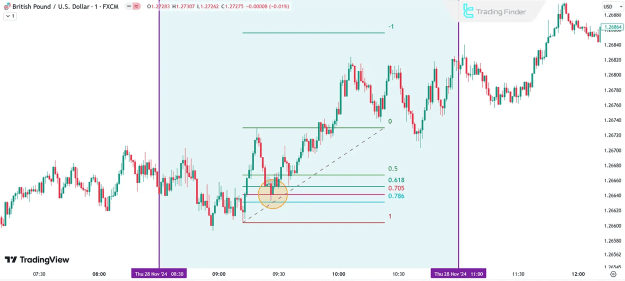
This illustration demonstrates the application of the OTE strategy in an uptrend:
- Higher timeframe analysis confirms an established uptrend.
- A new bullish price movement breaks a prior market structure.
- Fibonacci levels are drawn from the swing low to the swing high.
- The trade occurs within the 8:30 AM to 11:00 AM New York time window.
- Price retraces into the OTE zone (e.g., 70.5% level).
- Enter the trade with a stop-loss positioned below the 100% Fibonacci level and a take-profit target at the previous high.
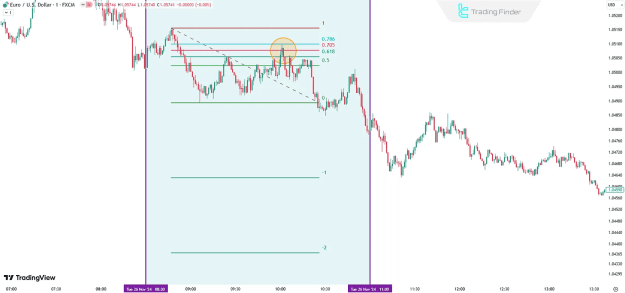
OTE in a Downtrend
The principles applied in an uptrend are mirrored for a downtrend scenario.
Key Tips for Success in OTE
- Consistently analyze higher timeframes to ascertain the dominant market trend.
- Initiate trades only after a clear liquidity grab has occurred.
- Always confirm a structure break on lower timeframes before entry.
- Strictly adhere to the specified trading time window (8:30 AM to 11:00 AM New York time).
- Maintain rigorous discipline and implement robust risk management practices for sustained success.
Common Mistakes Traders Make with OTE Setup
- Neglecting to analyze the main trend in higher timeframes.
- Applying the strategy outside its designated specific time window.
- Misinterpreting the market structure break.
- Incorrectly setting the starting and ending points for Fibonacci tool application.
- Executing trades against the prevailing main trend.
What Markets are Suitable for OTE Setup?
The OTE strategy is highly effective in markets such as Forex, NYSE stocks, futures, and indices. This effectiveness stems from the strategy's alignment with the liquidity dynamics of the New York trading session. It tends to be less effective in markets that are not directly correlated with New York trading hours.
Conclusion
The ICT style and the OTE tool collectively empower traders to identify optimal entry and exit points with exceptional precision. This methodology offers significant advantages, particularly for retail traders and scalpers, due to its focus on specific timeframes and its detailed consideration of underlying market behavior.