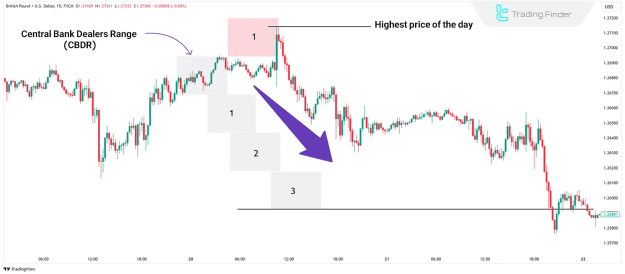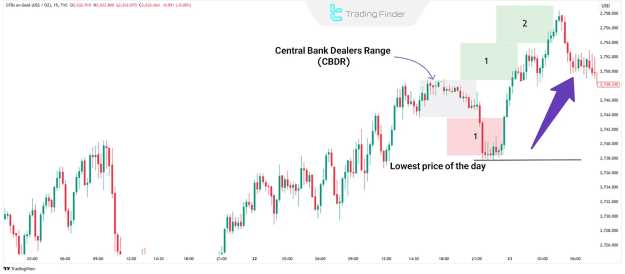


This range is calculated based on prices observed between 2:00 PM and 8:00 PM New York time. The CBDR can be expanded by incorporating deviations above and below the average price, reflecting the dispersion of prices relative to the mean. It's a powerful tool for identifying potential breakouts or reversals and helps in guiding daily bias on higher timeframes.
Macro ICT Indicator:
Macro ICT Indicator MT4
Macro ICT Indicator MT5
What is the Central Bank Dealers Range (CBDR)?
In ICT Strategy, the CBDR price range is instrumental in forecasting a trading day's highest and lowest prices. This range is calculated between 2:00 PM and 8:00 PM New York time. Deviations from the average price can be used to estimate higher or lower ranges, reflecting how prices are dispersed around the mean.
What Range is Ideal for CBDR?
- Range Height: This is determined by finding the highest and lowest prices within the specified time. While candlestick bodies are preferred, wicks can be included if the bodies are exceptionally small.
- Optimal Range: Ideally, the CBDR should be less than 40 pips, with ranges between 10 to 20 pips yielding superior results.
- Larger Ranges: For ranges exceeding 40 pips, short-term trades tend to exhibit better performance.
Advantages of Using CBDR
- Precise Forecasting: CBDR empowers traders to predict price movements with enhanced accuracy.
- Risk Reduction: It facilitates informed decision-making, helping traders avoid high-risk exposures.
- Increased Profitability: By identifying high-probability trading opportunities, CBDR can boost profitability.
- Flexibility: The CBDR methodology is adaptable across various markets and timeframes.
How to Use CBDR in Trading?
Typically, the market aims to move the price at least one to two times the CBDR range against the prevailing trend to gather liquidity. Subsequently, it moves four steps in the direction of the trend, equivalent to the daily CBDR range.
Bearish Days
On bearish days, the ideal scenario involves the price exceeding the CBDR range by no more than two units, commonly moving just one unit upward to collect liquidity. The day's lowest price can often be predicted as three units below the CBDR range, frequently observed towards the end of the London trading session.
Bullish Days
Conversely, on bullish days, the optimal scenario sees the price dropping no more than two units below the CBDR range, typically moving just one unit downward to collect liquidity. The day's highest price can be predicted as three units above the CBDR range, often manifesting at the close of the London trading session.
Which Timeframes Are Suitable for CBDR?
The most effective timeframes for applying CBDR are 15-minute and 30-minute intervals:
- 15 Minutes: This timeframe is ideal for short-term trades, offering a more precise view of price fluctuations.
- 30 Minutes: This interval provides a broader perspective, better suited for overall analysis and long-term planning.
Which Currency Pairs and Assets Are Suitable for CBDR?
While initially developed for trading NASDAQ and S&P500 indices, the CBDR method has successfully expanded to other financial markets, including forex and precious metals. Currency pairs like GBP/USD and EUR/USD are excellent choices for this strategy. Additionally, it has shown strong performance in the gold market (XAU/USD).
How to Achieve Better Results with CBDR?
To optimize results with CBDR, traders should adhere to the following principles:
- Precise identification of the CBDR range.
- Effective risk and capital management.
- Thorough analysis of news and prevailing market conditions.
- Patience and disciplined trading under ideal conditions.
What Role Do Central Banks Play in CBDR?
Central banks and smart money exert significant influence over the CBDR and its formation through various actions:
- Interest Rate Decisions: These decisions directly impact price volatility and the CBDR range. Traders can monitor these changes using tools like the TradingFinder Central Bank Interest Rates Tool.
- Monetary Stimulus Actions: Such actions influence price ranges by either increasing or decreasing market liquidity.
- Currency Interventions: These interventions can lead to sudden and notable shifts in the CBDR range.
Which Days of the Week Are Best for CBDR?
Certain days of the week offer more favorable conditions for CBDR-based trades:
- Tuesdays and Wednesdays: These days frequently mark weekly highs or lows, presenting increased opportunities for CBDR-driven strategies.
- Days with Significant Economic News: High-impact news releases, such as interest rate decisions, employment reports, or inflation data, can generate substantial volatility, pushing prices towards CBDR targets.
- Overlap of Trading Sessions: The overlap between the London and New York trading sessions, often referred to as the "kill zone," is characterized by high trading volume and numerous suitable trading opportunities.
Conclusion
The Central Bank Dealers Range (CBDR) is a sophisticated approach designed to pinpoint daily price highs and lows within a trading day. This methodology integrates time analysis, price ranges, and central bank behavior, empowering traders to make more informed decisions in their daily trading activities.