

Judas Swing Indicator (ICT):
Judas Swing Indicator (ICT) MT4
Judas Swing Indicator (ICT) MT5
What is an ICT Judas Swing?
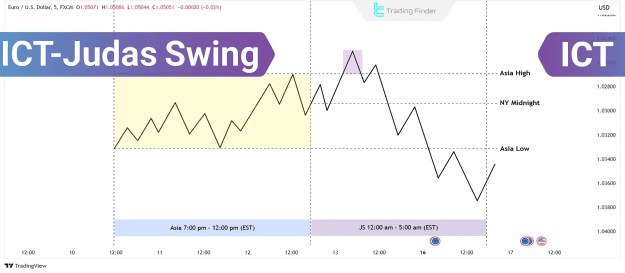
An ICT Judas Swing represents a deceptive price movement engineered to misguide retail traders.
- Initially, the price moves temporarily in a specific direction, fostering a false sense of trend continuation.
- Subsequently, the trend abruptly reverses, and the market shifts in the opposite direction.
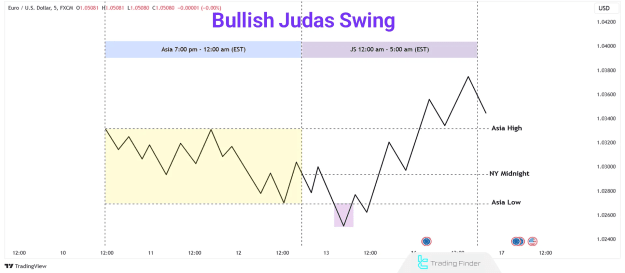
1. ICT Bullish Judas Swing
In a Bullish Judas Swing, a false downward move below the opening price deceives traders into anticipating a continuing downtrend. The price then reverses upward, facilitating liquidity collection.
- Smart Money triggers the stop-losses of traders who initiated buy positions at the opening price, compelling them to sell.
- As retail traders sell, Smart Money accumulates liquidity, driving the market upward.
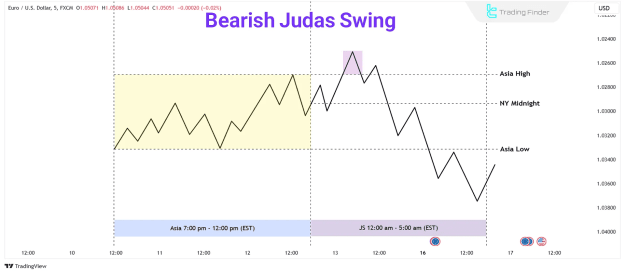
2. ICT Bearish Judas Swing
Conversely, in a Bearish Judas Swing, a false upward move above the opening price misleads traders into believing an uptrend will persist. The price then reverses downward, enabling liquidity collection.
- Smart Money activates the stop-losses of traders who initiated sell positions, forcing them to buy back.
- As retail traders buy, Smart Money gathers liquidity, pushing the market downward.
When Does the ICT Judas Swing Occur?
The ICT Judas Swing primarily manifests between the New York Midnight Open (00:00) and 5:00 AM New York Time.
- It frequently coincides with the London session opening at 3:00 AM New York Time, developing between the start of the London session and 5:00 AM.
- To refine the identification of Judas Swings, traders can utilize specialized indicators available on platforms such as MetaTrader or TradingView.
How to Trade the ICT Judas Swing
Successful execution of the ICT Judas Swing strategy necessitates first determining the accurate Daily Bias. Daily Bias refers to the anticipated market direction for the trading day, established through various technical analysis methodologies. With a confirmed Daily Bias, the ICT Judas Swing strategy can be effectively applied.
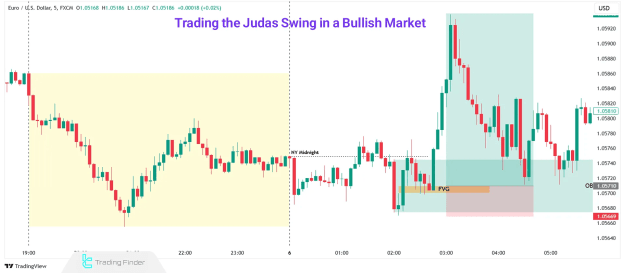
Trading the Judas Swing in a Bullish Market
To trade the ICT Bullish Judas Swing in a bullish market, adhere to these steps:
- Identify the New York Open Price.
- Spot a false downward move that extends below the opening price.
- Detect a market structure shift (MSS) upward following the false downward move.
- Once liquidity below the opening price has been collected and the market structure shifts upward (between 00:00 and 5:00 AM New York Time):
- Identify a Fair Value Gap (FVG) or a Bullish Order Block (OB+) on the buy side.
- Enter a buy trade when the price retraces to the identified order block or FVG.
- Set the stop-loss a few pips below the Judas Swing low.
- For take-profit, target buy-side liquidity (BSL).
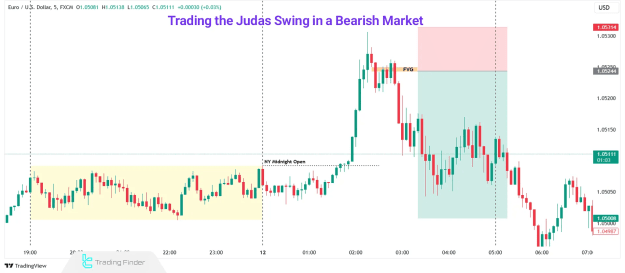
Trading the Judas Swing in a Bearish Market
To trade the ICT Bearish Judas Swing in a bearish market, follow these steps:
- Identify the New York Open Price.
- Spot a false upward move that extends above the opening price.
- Detect a market structure shift (MSS) downward following the false upward move.
- Once liquidity above the opening price has been collected and the market structure shifts downward (between 00:00 and 5:00 AM New York Time):
- Identify a Fair Value Gap (FVG) or a Bearish Order Block (OB-) on the sell side.
- Enter a sell trade when the price retraces to the identified order block or FVG.
- Set the stop-loss a few pips above the Judas Swing high.
- For take-profit, target sell-side liquidity (SSL).
Final Notes
The ICT Judas Swing Strategy capitalizes on false price movements that occur during specific time windows (between Midnight and 5:00 AM New York Time). These moves are orchestrated by Smart Money to trigger stop-losses and manipulate market liquidity. Successful application of this strategy demands precise identification of market structure shifts and robust validation of the Daily Bias. Accurate tools such as Fair Value Gaps and Order Blocks are instrumental in determining optimal entry and exit points for trades.