



Hi. In this occasional thread I will detail my thoughts from a long and successful trading career, first as a Bank prop trader, then a Hedge Fund trader, (both essentially from Global Macro/Fundie analysis,) then an own account Technical trader.
Someone recently referred to the phenomenon of information pollution on the internet, and this is certainly true of trading. The perverse irony of having almost too much information at your fingertips is that most traders don't even know what it is they have to know to become reliably and consistently profitable from their trading activity. Read that again, it is very important! Ask yourself the question - do you even truly know what it is you need to know let alone know it?
So I'll start with the very basics, and inspired by the late great Mark Douglas (Trading in the Zone etc...) the information below is what I believe you simply have to accept as self evident truths about first; any financial market/instrument, and secondly; the actual trading of such.
Feel free to comment, although I'm not necessarily inviting it - the thread is more to impart information.
Watch out for further posts.
10 Self-evident Truths about any financial market/trading instrument:
1. The market doesn’t know you exist. Although it can be a dangerous place, it means you no harm. It is not personal.
2. The market doesn’t care what you think, feel, hope, or expect.
3. The market is never wrong. At any point in time it is the prevailing net will of all buyers and sellers involved in it to that point in time.
4. The market is in a constant quest for balance/equilibrium.
5. Re 4. above, When the market is rising it is looking for sellers to fill the imbalance of demand over supply, and achieve balance. Conversely, when the market is falling, it is looking for buyers to fill the imbalance of supply over demand, and achieve balance.
6. The market will hunt your stops, but again, it’s nothing personal, it’s just looking for liquidity.
7. The market acts as an efficient mechanism to transfer wealth from those without an edge, and/or the discipline/psychology to trade it profitably, to those only with both.
8. The market is probably a mixture of randomness, chaos, efficiency, and order, but whatever the actual mix at any given time, market reactions and behaviour do repeat, but not always.
9. The market offers only one real constant; and that is change, and only one real certainty; and that is uncertainty.
10. Every moment in the market is almost certainly unique, – comprised of different buyers and sellers, @ different volumes, for different reasons, than the last one.
10 Self-evident Truths about trading any financial market/instrument;
1. You don’t need to know what is going to happen next to make money.
2. You need a proven trading edge with a positive expectancy, (proven in the live market by you, not a third party, - over a representative sample [s] of instances on the t/f /horizon [s,] on the trading instrument [s,] and in the market conditions you intend to trade it in.) You also need to have developed the necessary personal psychology to trade your edge as it needs to be traded, (ie per it’s rules,) to be profitable over the given sample size of individual trades that it is theoretically net profitable over.
3. It is very highly unlikely to an almost certainty that you can make prediction your edge. This is not to say that you might not encounter luck for howsoever long using prediction, but over the longer-term, for consistent year-on-year profitability, you would be best advised to look for/develop an analysis based edge.
4. You should seek to obtain a trading edge through whatsoever analysis that results in you identifying repeating patterns of market behaviour, that in technical trading for example present themselves as repeating patterns/set-ups (howsoever comprised,) on a time –vs- price chart. In this way you will be trading what you see - not what you think, feel, hope, or expect.
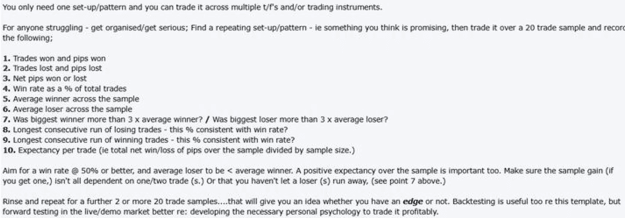
5. You need to know the relevant/pertinent stats about your trading edge to ensure that you always know that it is performing within it’s known historical boundaries. These include win rate, and % chances of whatsoever consecutive losing runs of trades @ the win rate etc. Your risk profile to trade the edge should be optimised to the performance stats of it.
6. There is a random distribution between winning trades and losing trades for any given set of variables that define an edge. Ie; when your edge sets-up and you make a market entry, you don't know on any given instance whether it will result in a winning trade or losing trade. All you know is that over a pre-determined sample of instances it does and you act on it, (based on historical precedent to that point in time,) you will realise a net gain over that sample as a whole, provided you trade the edge correctly.
7. The ‘battle’ in trading is not with the market, but with yourself.
8. Trading is a very personal thing. There are few absolute rights and absolute wrongs, but you have to able to first understand, and then deal with risk and uncertainty, and learn to think not in certainties, but in probabilities.
9. Anything can happen. Market Participants or Commentators who say they know for a 100% certainty what will happen next to price are lying both to themselves, but worse than that, to others. Beware of ‘false prophets!’
10. There will almost certainly be a lead-time of whatsoever duration before you become reliably and consistently profitable from your trading activity, and that is only providing you have achieved points 2,and5, detailed above.
Someone recently referred to the phenomenon of information pollution on the internet, and this is certainly true of trading. The perverse irony of having almost too much information at your fingertips is that most traders don't even know what it is they have to know to become reliably and consistently profitable from their trading activity. Read that again, it is very important! Ask yourself the question - do you even truly know what it is you need to know let alone know it?
So I'll start with the very basics, and inspired by the late great Mark Douglas (Trading in the Zone etc...) the information below is what I believe you simply have to accept as self evident truths about first; any financial market/instrument, and secondly; the actual trading of such.
Feel free to comment, although I'm not necessarily inviting it - the thread is more to impart information.
Watch out for further posts.
10 Self-evident Truths about any financial market/trading instrument:
1. The market doesn’t know you exist. Although it can be a dangerous place, it means you no harm. It is not personal.
2. The market doesn’t care what you think, feel, hope, or expect.
3. The market is never wrong. At any point in time it is the prevailing net will of all buyers and sellers involved in it to that point in time.
4. The market is in a constant quest for balance/equilibrium.
5. Re 4. above, When the market is rising it is looking for sellers to fill the imbalance of demand over supply, and achieve balance. Conversely, when the market is falling, it is looking for buyers to fill the imbalance of supply over demand, and achieve balance.
6. The market will hunt your stops, but again, it’s nothing personal, it’s just looking for liquidity.
7. The market acts as an efficient mechanism to transfer wealth from those without an edge, and/or the discipline/psychology to trade it profitably, to those only with both.
8. The market is probably a mixture of randomness, chaos, efficiency, and order, but whatever the actual mix at any given time, market reactions and behaviour do repeat, but not always.
9. The market offers only one real constant; and that is change, and only one real certainty; and that is uncertainty.
10. Every moment in the market is almost certainly unique, – comprised of different buyers and sellers, @ different volumes, for different reasons, than the last one.
10 Self-evident Truths about trading any financial market/instrument;
1. You don’t need to know what is going to happen next to make money.
2. You need a proven trading edge with a positive expectancy, (proven in the live market by you, not a third party, - over a representative sample [s] of instances on the t/f /horizon [s,] on the trading instrument [s,] and in the market conditions you intend to trade it in.) You also need to have developed the necessary personal psychology to trade your edge as it needs to be traded, (ie per it’s rules,) to be profitable over the given sample size of individual trades that it is theoretically net profitable over.
3. It is very highly unlikely to an almost certainty that you can make prediction your edge. This is not to say that you might not encounter luck for howsoever long using prediction, but over the longer-term, for consistent year-on-year profitability, you would be best advised to look for/develop an analysis based edge.
4. You should seek to obtain a trading edge through whatsoever analysis that results in you identifying repeating patterns of market behaviour, that in technical trading for example present themselves as repeating patterns/set-ups (howsoever comprised,) on a time –vs- price chart. In this way you will be trading what you see - not what you think, feel, hope, or expect.
5. You need to know the relevant/pertinent stats about your trading edge to ensure that you always know that it is performing within it’s known historical boundaries. These include win rate, and % chances of whatsoever consecutive losing runs of trades @ the win rate etc. Your risk profile to trade the edge should be optimised to the performance stats of it.
6. There is a random distribution between winning trades and losing trades for any given set of variables that define an edge. Ie; when your edge sets-up and you make a market entry, you don't know on any given instance whether it will result in a winning trade or losing trade. All you know is that over a pre-determined sample of instances it does and you act on it, (based on historical precedent to that point in time,) you will realise a net gain over that sample as a whole, provided you trade the edge correctly.
7. The ‘battle’ in trading is not with the market, but with yourself.
8. Trading is a very personal thing. There are few absolute rights and absolute wrongs, but you have to able to first understand, and then deal with risk and uncertainty, and learn to think not in certainties, but in probabilities.
9. Anything can happen. Market Participants or Commentators who say they know for a 100% certainty what will happen next to price are lying both to themselves, but worse than that, to others. Beware of ‘false prophets!’
10. There will almost certainly be a lead-time of whatsoever duration before you become reliably and consistently profitable from your trading activity, and that is only providing you have achieved points 2,and5, detailed above.
Trader with an Edge.




 like your handle and pic
