
-
NZ: OCR on hold at 2.25% with inflation expected to fall

Annual consumers price inflation was slightly above the Monetary Policy Committee’s 1 to 3 percent target band at the end of 2025. Increases in food and electricity prices and local council rates were the biggest contributors to above-target inflation. The economy is at an early stage in its recovery. With ongoing strength in commodity prices, economic activity in the agricultural sector and regional New Zealand remains strong. Although residential and business investment is increasing, households remain cautious in their spending. The labour market is stabilising, but unemployment remains elevated. House price ... (full story)
Added at 7:06pm
- The Monetary Policy Committee today agreed to keep the Official Cash Rate on hold at 2.25%. Inflation is expected to be back within our 1-3% target range in the first quarter of 2026.
The economy is at an early stage of recovery, and growth is expected to increase over 2026. Any future moves in the Official Cash Rate will depend on how the economy unfolds. Read more: https://t.co/sd09BHJPVE
#rbnz #MPS #MonetaryPolicyStatement #OCR #OfficialCashRate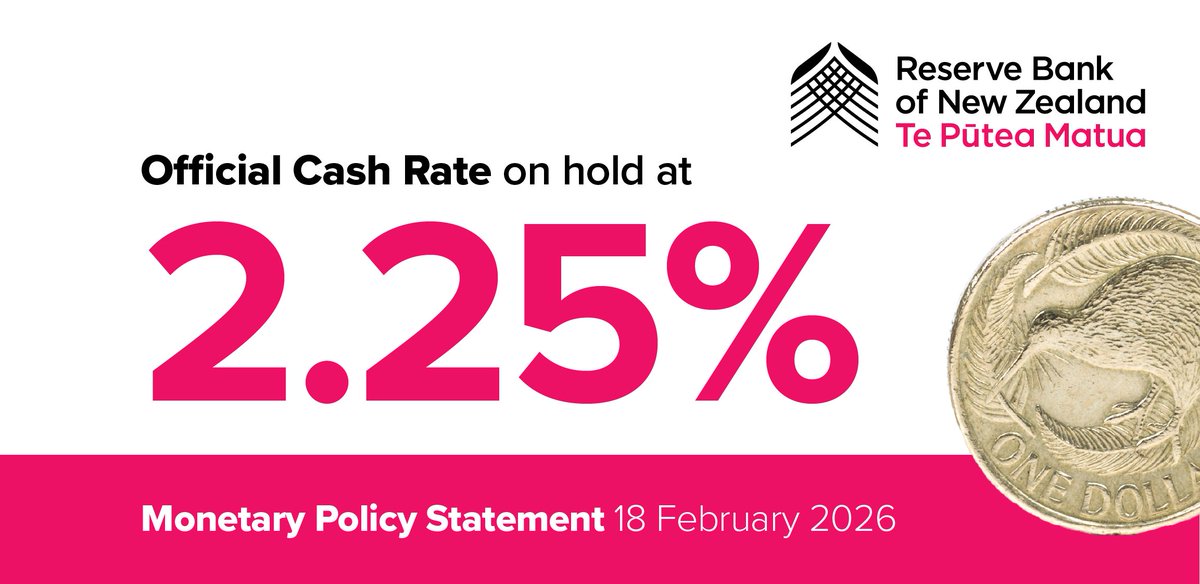


Added at 7:10pm

Added at 7:10pm

Added at 7:10pm
- Comments / Top
- Subscribe

johan4292
Feb 17, 2026 8:26pm
Permalink
Trader#E851
Feb 17, 2026 7:09pm
Permalink
Trader#3822
Feb 17, 2026 7:48pm
Permalink
Trader#3CD7
Feb 17, 2026 7:54pm
Permalink
Trader#B54E
Feb 17, 2026 8:03pm
Permalink
-
Related Stories



Annual consumers price inflation was slightly above the Monetary Policy Committee’s 1 to 3 percent target band at the end of 2025. Increases in food and electricity prices and local council rates were the biggest contributors to above-target inflation. The economy is at an early stage in its recovery. With ongoing strength in commodity prices, economic activity in the agricultural sector and regional New Zealand remains strong. Although residential and business investment is increasing, households remain cautious in their spending. The labour market is stabilising, but unemployment remains elevated. House price growth remains weak, dampening household wealth and inclination to spend. In response to previous cuts in the OCR, economic growth is broadening across sectors of the economy, such as manufacturing, construction and some retail. Economic growth is expected to increase over 2026. RESERVE BANK OF NEW ZEALAND SEES OFFICIAL CASH RATE AT 3% IN MARCH 2029 RESERVE BANK OF NEW ZEALAND SEES ANNUAL CPI 2.1% BY MARCH 2027 RESERVE BANK OF NEW ZEALAND SEES OFFICIAL CASH RATE AT 2.52% IN MARCH 2027 VERSUS 2.34% OCR ON HOLD AT 2.25 PERCENT AS INFLATION EXPECTED TO… Just in | RBNZ projects NZD's Trade-Weighted Index to reach approximately 68.0% by March 2027.

FED’S DALY: AI INVESTMENT COULD LIFT DEMAND AND ADD TO INFLATIONARY PRESSURES, WHILE PRODUCTIVITY GAINS ARE DISINFLATIONARY; IMPACT DEPENDS ON TIMING. FED’S DALY: INFLATION REMAINS ABOVE TARGET AND HOUSEHOLDS ARE FEELING FINANCIAL STRAIN. ... Fed's Daly: Too far to link productivity growth all to AI, but something is definitely happening in productivity. FED'S DALY SAYS WORKER ANXIETY IS ELEVATED BUT AI ISN'T TAKING ALL JOBS Breaking | Federal Reserve's Daly Confirms AI is Not Currently Used in Monetary Policy Decisions.

Thank you for the invitation to speak to you today.1 Before I get into my main topic, I wanted to share my current views on the economy and monetary policy. Last week, we received the latest report on employment, and it provided further evidence that while the labor market slowed through last summer, it is now stabilizing. This stabilization is occurring with an unemployment rate that is broadly consistent with what many estimate is its long-run level, when the economy is in balance. That said, job creation has been near zero over the course of last year, as has labor force growth. With very low levels of job creation and also a low firing rate, there seems to be a tentative balance in labor supply and demand. But it is a delicate balance, and that means that the labor market could be especially vulnerable to negative shocks. Turning to the other component of our mandate, inflation based on personal consumption expenditures remains elevated at 3 percent, about where it was a year ago. Disinflation, which started in mid-2022, slowed last year, as goods price inflation picked up, in large part due to tariffs. That pattern appeared to continue in the inflation data released last week. Looking ahead, it is reasonable to forecast that tariff effects on inflation will begin to abate later this year, but there are many reasons to be concerned that inflation will remain elevated. I see the risk of persistent inflation above our 2 percent target as significant, which means we need to remain vigilant. The prudent course for monetary policy right now is to take the time necessary to assess conditions as they evolve. I would like to see evidence that goods price inflation is sustainably retreating before considering reducing the policy rate further, provided labor market conditions remain stable. Based on current conditions and the data in hand, it will likely be appropriate to hold rates steady for some time as we assess incoming data, the evolving outlook, and the balance of risks. FED’S BARR: PRUDENT TO TAKE TIME, LOOK AT DATA, BEFORE CHANGING FED POLICY AGAIN - OUTLOOK SUGGESTS FED WILL HOLD RATES ‘STEADY FOR SOME TIME’ - AI BOOM IS UNLIKELY TO BE A REASON FOR LOWERING POLICY RATE - AI COULD RAISE NEUTRAL RATE, IMPLY HIGHER SETTING FOR POLICY ...
