
-
Time of Higher Silver Volatility: Markets Surprised by Fed Policy Shift

Recent days have brought significant changes in investor expectations regarding the Federal Reserve’s monetary policy, which have notably impacted the futures market, bond yields, and precious metals – especially silver. The rising probability of a rate cut in December has triggered increased price volatility in the silver market, potentially signaling more dynamic movements in the weeks ahead. On Friday, the price of 30-day federal funds futures for December rose from 96.175 to 96.215, accompanied by a record trading volume of 255.63 thousand contracts – more than three times the 20-day average. The surge in ... (full story)
- Comments / Top
- Subscribe
-
Related Stories


Fed's Logan: The Fed should hold rates steady for a time to assess degree of restriction.  Opening remarks for panel titled ‘Economic uncertainty and the design and conduct of monetary policy’ Good afternoon. Thank you to the Karl Brunner Institute for inviting me to participate in this important conference. As always, the views I’ll share are mine and not necessarily those of my colleagues on the Federal Open Market Committee (FOMC). It is an honor to join this distinguished panel addressing a topic that is both timely and timeless: the role of economic uncertainty in monetary policy. The topic is timely because this is a moment of substantial uncertainty about the economic outlook. And it is timeless because, really, there’s nothing especially new about that situation. Uncertainty is a pervasive feature of the macroeconomy and monetary policymaking. Theoretical models in which one knows the precise current state of the economy, fully understands the economic mechanisms and has perfect foresight about the future can sometimes provide useful baseline approximations. But these are merely approximations. The world is complex, multifaceted and ever-changing. A policymaker cannot know with certitude the current state of every relevant aspect of the economy, let alone exactly how every part of the economy works or what shocks may arrive. Yet policymakers must still make policy decisions. Even a choice not to act is itself a decision. And we cannot let uncertainty paralyze us. Rather, it’s incumbent on policymakers to tackle uncertainty head-on. First off, policymakers can reduce uncertainty about the state of the economy by gathering economic information from a wide range of sources. For me, those sources include official statistics, private-sector data, financial market conditions, surveys of households and businesses, and reports from business and community leaders and market contacts about what they are seeing in the economy and financial system. Besides sharpening the economic picture, taking on information from a wide range of sources makes the policy process more robust to disruptions in the flow of information from any one source, such as the government shutdown in the United States that recently paused publication of many federal official statistics . But even after thorough information-gathering, some uncertainty will always remain. Fed's Logan: October rate cut was not warranted. FED'S LOGAN SAYS REPEATS SHE WOULD FIND IT DIFFICULT TO SUPPORT DECEMBER RATE CUT || INFLATION TOO HIGH, LABOR MARKET ROUGHLY BALANCED
Opening remarks for panel titled ‘Economic uncertainty and the design and conduct of monetary policy’ Good afternoon. Thank you to the Karl Brunner Institute for inviting me to participate in this important conference. As always, the views I’ll share are mine and not necessarily those of my colleagues on the Federal Open Market Committee (FOMC). It is an honor to join this distinguished panel addressing a topic that is both timely and timeless: the role of economic uncertainty in monetary policy. The topic is timely because this is a moment of substantial uncertainty about the economic outlook. And it is timeless because, really, there’s nothing especially new about that situation. Uncertainty is a pervasive feature of the macroeconomy and monetary policymaking. Theoretical models in which one knows the precise current state of the economy, fully understands the economic mechanisms and has perfect foresight about the future can sometimes provide useful baseline approximations. But these are merely approximations. The world is complex, multifaceted and ever-changing. A policymaker cannot know with certitude the current state of every relevant aspect of the economy, let alone exactly how every part of the economy works or what shocks may arrive. Yet policymakers must still make policy decisions. Even a choice not to act is itself a decision. And we cannot let uncertainty paralyze us. Rather, it’s incumbent on policymakers to tackle uncertainty head-on. First off, policymakers can reduce uncertainty about the state of the economy by gathering economic information from a wide range of sources. For me, those sources include official statistics, private-sector data, financial market conditions, surveys of households and businesses, and reports from business and community leaders and market contacts about what they are seeing in the economy and financial system. Besides sharpening the economic picture, taking on information from a wide range of sources makes the policy process more robust to disruptions in the flow of information from any one source, such as the government shutdown in the United States that recently paused publication of many federal official statistics . But even after thorough information-gathering, some uncertainty will always remain. Fed's Logan: October rate cut was not warranted. FED'S LOGAN SAYS REPEATS SHE WOULD FIND IT DIFFICULT TO SUPPORT DECEMBER RATE CUT || INFLATION TOO HIGH, LABOR MARKET ROUGHLY BALANCED
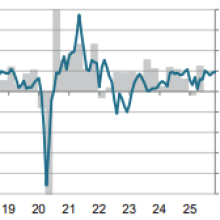
US business activity growth accelerated for a second successive month in November, according to early ‘flash’ PMI data, accompanied by the largest rise in new business seen so far this year. Confidence in the year ahead outlook also improved markedly, notably reflecting reduced worries over the political environment and hopes for increased policy support to ...

Federal Reserve Bank of New York President John Williams said he sees room for the US central bank to cut interest rates again in the near term as the labor market softens. In the text of a speech he delivered Friday in Santiago, Chile, Williams said downside risks to employment have increased while upside risks to inflation have eased. “I view monetary ...
