
-
Bank of Canada: Monetary Policy Report—October 2025

The Canadian economy is adjusting to steep US tariffs on several industries and coping with elevated uncertainty. Tariffs have led to a fall in the demand for Canadian goods, affecting the broader economy. The reconfiguration of global trade and domestic production is also leading to higher costs. Total inflation has been around 2%, while underlying inflation has continued to be about 2½%. With US tariffs and limited Canadian counter-tariffs in place, the effects of the trade conflict on growth and inflation in Canada are becoming clearer. Exports to the United States have fallen, and business investment has ... (full story)
Added at 8:47am


Added at 8:48am
Added at 8:49am
- Comments / Top
- Subscribe
Trader#9BDE
Oct 29, 2025 8:47am
Permalink
-
Related Stories


The Bank of Canada today reduced its target for the overnight rate by 25 basis points to 2.25%, with the Bank Rate at 2.5% and the deposit rate at 2.20%. With the effects of US trade actions on economic growth and inflation somewhat clearer, the Bank has returned to its usual practice of providing a projection for the global and Canadian economies in this Monetary Policy Report (MPR). Because US trade policy remains unpredictable and uncertainty is still higher than normal, this projection is subject to a wider-than-usual range of risks. While the global economy has been resilient to the historic rise in US tariffs, the impact is becoming more evident. Trade relationships are being reconfigured and ongoing trade tensions are dampening investment in many countries. In the MPR projection, the global economy slows from about 3¼% in 2025 to about 3% in 2026 and 2027. In the United States, economic activity has been strong, supported by the boom in AI investment. At the same time, employment growth has slowed and tariffs have started to push up consumer prices. Growth in the euro area is decelerating due to weaker exports and slowing domestic demand. In China, lower exports to the United States have been offset by higher exports to other countries, but business investment has weakened. Global financial conditions have eased further since July and oil prices have been fairly stable. The Canadian dollar has depreciated slightly against the US dollar. Canada’s economy contracted by 1.6% in the second quarter, reflecting a drop in exports and weak business investment amid heightened uncertainty. Meanwhile, household spending grew at a healthy pace. US trade actions and related uncertainty are having severe effects on targeted sectors including autos, steel, aluminum, and lumber. As a result, GDP growth is expected to be weak in the second half of the year. Growth will get some support from rising consumer and government spending and residential investment, and then pick up gradually as exports and business investment begin to recover. BOC SAYS IT EXPECTS INFLATIONARY PRESSURES TO EASE IN THE MONTHS AHEAD BOC: CANADIAN LABOR MARKET REMAINS SOFT; EXCESS CAPACITY IN THE ECONOMY IS EXPECTED TO PERSIST AND BE TAKEN UP GRADUALLY Macklem says current policy rate is "about the right level" BOC: IF THE OUTLOOK CHANGES WE ARE PREPARED TO RESPOND
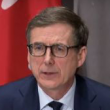
Good morning. I’m pleased to be here with Senior Deputy Governor Carolyn Rogers to discuss today’s monetary policy decision. Today, the Bank lowered the policy interest rate a further 25 basis points, bringing it to 2¼%. This was our second straight cut, and reflects ongoing weakness in the economy and contained inflationary pressures. Today we also published our outlook for the Canadian economy. We have four main messages. First, US tariffs and trade uncertainty have weakened the Canadian economy. We expect very modest growth through the rest of the year, with some pickup in 2026. Second, while this weakness is restraining price increases, the trade conflict is also adding costs for many businesses, putting upward pressure on inflation. We expect these opposing forces to roughly offset, keeping inflation close to the 2% target. Third, to support the economy through this period of adjustment, we have lowered our policy rate by 50 basis points over our last two meetings and by 100 basis points since the start of the year. And finally, the weakness we’re seeing in the Canadian economy is more than a cyclical downturn. It is also a structural transition. The US trade conflict has diminished Canada’s economic prospects. The structural damage caused by tariffs is reducing our productive capacity and adding costs. This limits the ability of monetary policy to boost demand while maintaining low inflation. For the first time since January and the start of the trade conflict, the Bank is publishing a baseline outlook for economic growth and inflation, rather than alternative scenarios. It has now been more than six months since we have been living with US tariffs. And while US trade policy remains unpredictable, its impacts are becoming clearer. Let me expand on what we’re seeing in the economy, and how that played into our deliberations. While the global economy has been resilient to the rise in US tariffs and increased uncertainty, the impacts are becoming more evident. Trade relationships are being reconfigured and uncertainty is dampening investment in many countries. In Canada, the impacts of US trade policy are already clearly apparent. GDP contracted 1.6% in the second quarter as tariffs and uncertainty reduced exports and business investment. US trade actions are having severe BoC's Gov. Macklem: There continues to be considerable uncertainty about US tariffs and their impacts. BoC's Gov. Macklem: Range of possible outcomes is wider than usual; we need to be humble about our forecast. BoC's Gov. Macklem: We expect opposing forces on inflation to roughly offset each other, keeping the overall rate close to 2%. BoC's Gov. Macklem: Monetary policy has limited ability to boost demand while maintaining low inflation, given the damage tariffs are doing to Canada's economic prospects.

Governor Tiff Macklem discusses the Monetary Policy Report and the key issues involved in the Governing Council’s deliberations about the monetary policy decision. The Governor and Senior Deputy Governor then answer questions from reporters.

