

TP & SL Tool: Risk Reward Ratio Calculator RRR MT5 | Prop Firm Protector: Trade Assist Prop Firm Plus TF Expert MT5 | Money Management + DrawDown Protector: Trade Panel Prop Firm Drawdawn Limiter Pro MT5 |Get a free Expert Advisor license via Telegram and WhatsApp
What Constitutes a Flip?
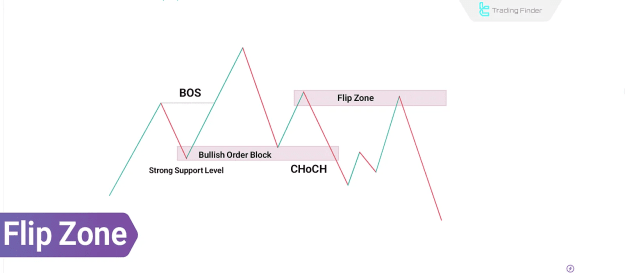
A Flip refers to a market condition where a significant supply or demand zone, after eliciting an initial price reaction, is definitively broken and transforms into its opposite. This phenomenon goes beyond a superficial breach; it reflects a genuine power shift between institutional participants and a redirection of liquidity flow.
Unlike a Change of Character (CHoCH), which primarily indicates structural shifts through the establishment of new highs and lows, a Flip specifically focuses on the valid breakage of existing zones and the formation of new trading areas. This provides deeper insights into the behavior of Smart Money.
Crucially, every Flip is inherently a CHoCH, but not every CHoCH qualifies as a Flip. A valid Flip necessitates the simultaneous fulfillment of three conditions:
- An initial price reaction to a pre-existing supply or demand zone.
- A clear and decisive break of that specific zone.
- The formation of an Imbalance or Fair Value Gap (FVG) at the exact moment of the break.
Types of Flip Patterns in Market Structure
Flip patterns in price action are generally categorized into two main types. In both instances, the underlying principle involves the breach of key supply or demand zones and their subsequent conversion into the opposing type. The distinction between them lies in the prevailing trend direction and the subsequent price objectives after the break.
Reversal Flip Pattern
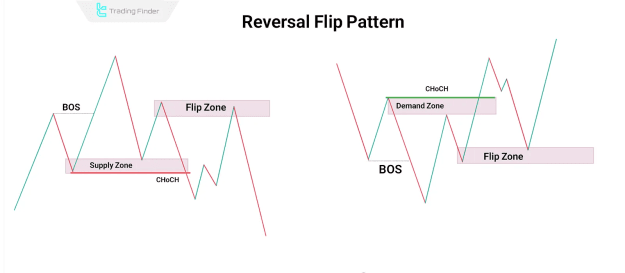
A Reversal Flip signals the conclusion of an existing trend and the initiation of a new trend in the opposite direction. Price initially interacts with a pivotal supply or demand zone but then breaks through it with considerable force, converting it into the opposite type of zone.
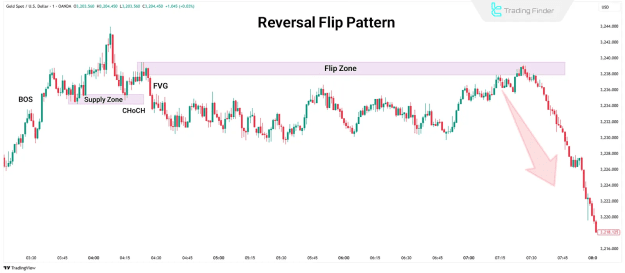
Beginning of a Downtrend: Price establishes higher highs and higher lows (HH/HL) before encountering a higher-timeframe supply zone. Following a brief reaction, price fails to establish a new high and instead breaks the preceding demand zone, thereby creating a new supply Flip Zone. This event indicates the termination of the uptrend and the commencement of a bearish phase.
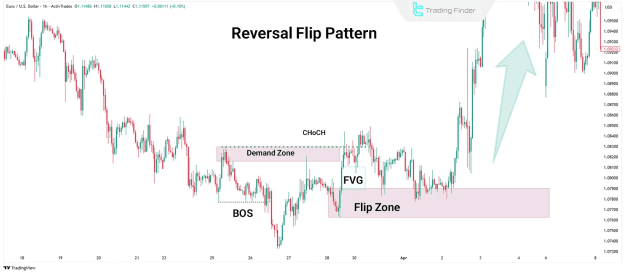
Beginning of an Uptrend: Price exhibits lower lows and lower highs (LL/LH) prior to engaging with a higher-timeframe demand zone. After an initial bounce, price fails to generate a new low and, instead, breaches the preceding supply zone, forming a new demand Flip Zone. This action signals the inception of a bullish trend.
Continuation Flip Pattern
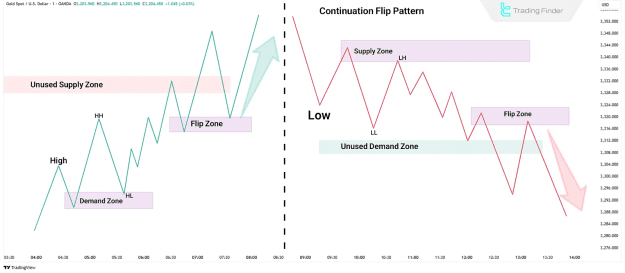
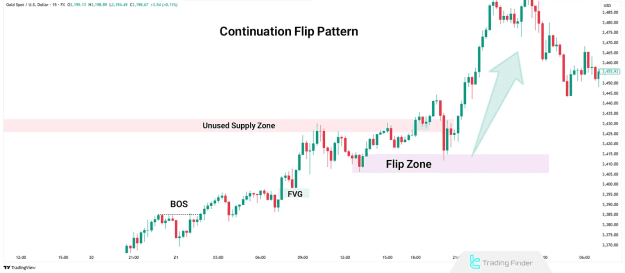
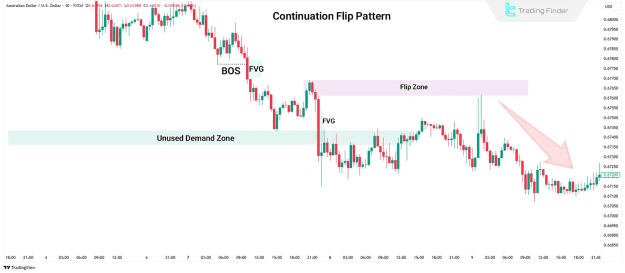
In contrast to the Reversal Flip, a Continuation Flip indicates the continuation of the prevailing trend. In this scenario, price breaks an opposing zone mid-trend and subsequently establishes it as new support or resistance.
Bullish Continuation (Supply to Demand Flip): Within an established uptrend, price reaches a supply zone that would typically trigger a pullback. However, price breaks through this zone with significant strength, leaving behind an Imbalance or FVG. The breaker candle forms a demand Flip Zone that commonly serves as an entry area for long positions moving forward.
Bearish Continuation (Demand to Supply Flip): During a downtrend, price enters a demand zone but breaches it without reversing, effectively transforming it into a supply Flip Zone. This action confirms the dominance of sellers and provides a basis for short setups in alignment with the existing trend.
Identifying Flip Zones
A Flip Level in ICT materializes when a significant supply or demand level is broken and subsequently re-established as its opposing type. It frequently serves as an area where price returns for institutional re-entry.
1. Identify the Key Zone in a Higher Time Frame
Commence your analysis on higher timeframes, as supply and demand zones observed on these scales tend to be more reliable and reflect genuine institutional decisions.
- If price enters and breaks a demand zone, the resulting Flip Zone is considered a supply zone.
- If price enters and breaks a supply zone, the resulting Flip Zone is considered a demand zone.
2. Observe Break with Strong Impulse & Imbalance/FVG
The break of the zone must be decisive and rapid, accompanied by an Imbalance or an FVG. This confirms the presence of substantial order flow and a clear shift in market ownership, increasing the likelihood of price returning to fill the void.
3. How to Mark a Flip Zone?
Following the decisive break, identify the candle that initiated the move. This candle is often located at the end of a pullback and the beginning of an impulse leg. To accurately delineate the Flip Zone:
- Mark the high and low of this specific candle using a rectangle.
- Anticipate price to return to this marked zone.
- The validity of the Flip Zone is further strengthened if the subsequent candle exhibits a large body and a clear gap.
4. How to Use Flip Zones for Entry
When price revisits the Flip in Price Action (typically to fill the associated imbalance), the most effective strategy involves utilizing limit orders within the zone:
- In a Bearish Reversal Flip, place a Sell Limit order within the supply Flip Zone.
- In a Bullish Reversal Flip, place a Buy Limit order within the demand Flip Zone.
- The Stop Loss (SL) should be positioned just beyond the Flip Zone.
- The Take Profit (TP) objective will depend on the newly formed market structure and target zones.
Note: Flip Zones are designed for single-use only. Once tested by price, they lose their efficacy as valid entry zones.
Conclusion
Within the framework of Smart Money Concept (SMC) and ICT, a Flip is characterized by an initial reaction to a supply or demand zone, its subsequent decisive break, and the simultaneous creation of an imbalance. Unlike a CHoCH, which merely reflects a structural change, a Flip specifically highlights a shift in market control.
There are two primary categories of Flips: Reversal and Continuation. The resulting Flip Zone maintains its validity only until its initial retest. Accurate analysis of these zones necessitates a comprehensive understanding that integrates price action, structural confirmation, and insights into liquidity flow.