

TP & SL Tool: Risk Reward Ratio Calculator RRR MT5 | Prop Firm Protector: Trade Assist Prop Firm Plus TF Expert MT5 | Money Management + DrawDown Protector: Trade Panel Prop Firm Drawdawn Limiter Pro MT5 |Get a free Expert Advisor license via Telegram and WhatsApp
Types of Divergence in Technical Analysis
Divergence is categorized into two principal types:
Regular Divergence
Regular Divergence occurs when the price of an asset and a momentum indicator move in opposing directions.
- Bearish (Negative) Divergence: This forms when the price records a higher high, but the corresponding indicator shows a lower high. This pattern suggests a potential downward reversal and weakness in the upward price movement.
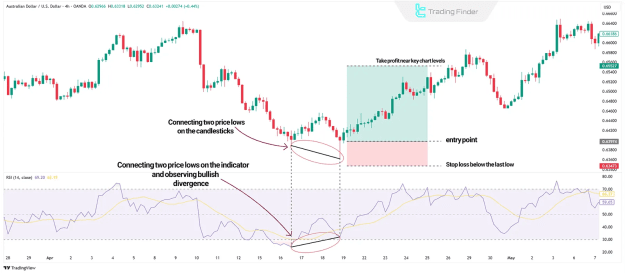
- Bullish (Positive) Divergence: Conversely, this appears when the price forms a lower low, while the indicator registers a higher low. This configuration indicates a possible upward reversal.
Regular divergence is frequently observed at the culmination of trends, signaling a decline in the strength of the current price action.
Hidden Divergence
Hidden Divergence typically signals the continuation of an existing trend and often emerges during market corrections or consolidations.
- Bullish Hidden Divergence: This occurs when the price forms a higher low, but the indicator displays a lower low. This pattern suggests that the prevailing uptrend is likely to continue.
- Bearish Hidden Divergence: This would be present if the price registers a lower high, while the indicator shows a higher high, implying the downtrend is likely to persist.
How to Trade with Divergence
Implementing divergence in trading strategies involves a systematic approach:
- Identifying Divergence: Utilize established technical indicators like the RSI, MACD, or Stochastic Oscillator. Compare the highs and lows of the indicator with the corresponding price action to identify the divergence.
- Confirming Divergence: Validate the divergence signal by cross-referencing with other technical analysis tools. This may include candlestick patterns, trendlines, or Fibonacci retracement levels, enhancing the reliability of the signal.
- Entering the Trade: Based on the identified divergence:
- For bullish divergence, consider initiating a buy trade.
- For bearish divergence, consider entering a sell trade.
- Risk Management: Implement robust risk management practices:
- Set a stop loss order to mitigate potential losses should the market move unfavorably against your position.
- Align take-profit levels with significant chart levels or Fibonacci targets to secure gains.
Divergence in Forex and Other Financial Markets
Divergence is a widely applied analytical technique across various financial markets, proving particularly valuable in the Forex market for analyzing currency trends. Given the heavy reliance on technical analysis in Forex trading, divergence serves as a crucial tool for identifying potential trend reversals and continuations. Beyond Forex, its utility extends to other asset classes, including stocks, cryptocurrencies, and commodities, providing actionable insights for traders.
Conclusion
Divergence stands as a valuable technique within technical analysis for effectively detecting shifts and continuations in market trends. It assists in pinpointing optimal entry and exit points for trades. For maximum effectiveness and enhanced reliability, divergence is best utilized in conjunction with other complementary technical indicators and analytical tools, such as the MACD and RSI.