

TP & SL Tool: Risk Reward Ratio Calculator RRR MT4 | Prop Firm Protector: Trade Assist Prop Firm Plus TF Expert MT4 | Money Management + DrawDown Protector: Trade Panel Prop Firm Drawdawn Limiter Pro MT4 |Get a free Expert Advisor license via Telegram and WhatsApp
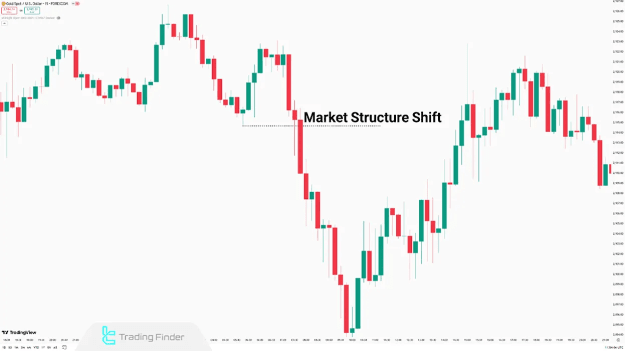
A Market Structure Shift occurs when the market breaks a significant structural level and begins forming a new series of price swings—marking a potential trend reversal. This shift reflects a change in institutional order flow, often seen on higher timeframes.
Characteristics of MSS:
- Occurs after a break of a major swing high (in a downtrend) or swing low (in an uptrend)
- Marks the transition from one trend to the opposite direction
- Accompanied by new higher highs and higher lows (in bullish reversals) or lower lows and lower highs (in bearish reversals)
- Often shows increased momentum and liquidity after the structural break
- Typically followed by a retracement or pullback to the broken level before continuation
How to Identify a Market Structure Shift:
- Begin by evaluating the existing market trend using recent highs and lows
- Look for a decisive break of a key swing point
- Confirm with the formation of a price structure in the opposite direction
- Observe liquidity expansion and strong directional candles
- Cross-check with higher timeframe market structure for additional confirmation
- Remain cautious of potential Liquidity Grabs during the transition phase
What Is a Liquidity Grab?
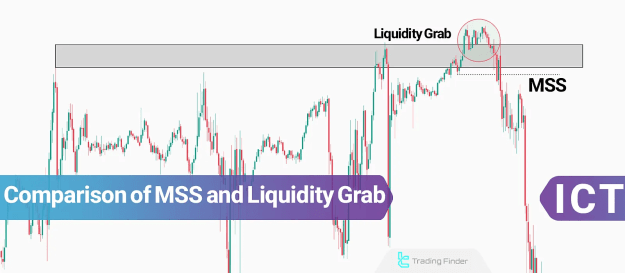
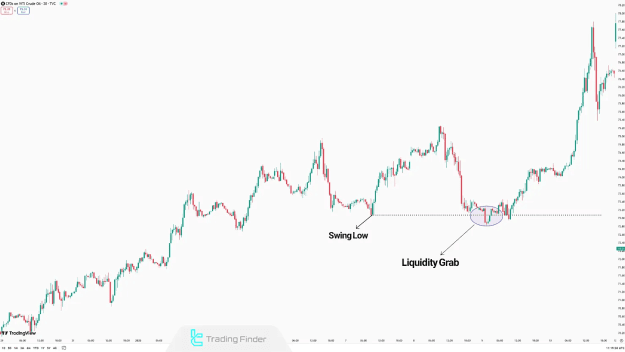
A Liquidity Grab is a deliberate false breakout that manipulates price to trigger stop-loss orders resting around obvious support or resistance zones. These setups aim to capture liquidity before the market resumes its original direction.
Key Features of a Liquidity Grab:
- Appears near major support/resistance or institutional price levels
- Price briefly violates the level and quickly reverses
- Commonly targets stop-loss clusters placed by retail traders
- Occurs with minimal momentum or follow-through
- Typically seen in lower timeframes (1M to 5M)
- Aims to facilitate large orders by inducing retail-driven volatility
How to Spot a Liquidity Grab:
- Price approaches a well-known support or resistance level
- Executes a swift breakout but fails to sustain above or below the level
- Rapid reversal indicates absorption of stop orders and liquidity injection
- Strong counter-move follows, often in line with the prevailing trend
- Works best with confirmation from order flow and volume data
MSS vs. Liquidity Grab: Key Differences
Understanding the distinctions between these two concepts helps prevent misinterpretation and failed trades.
Structural Behavior:
- MSS: Confirms a true trend reversal with consistent price structure
- Liquidity Grab: Triggers temporary moves to trap liquidity without structural change
Purpose:
- MSS: Indicates a genuine shift in institutional bias and trend direction
- Liquidity Grab: Exploits stop-loss zones to accumulate positions
Timeframe Relevance:
- MSS: Predominantly visible on higher timeframes (15M, 30M, 1H+)
- Liquidity Grab: Commonly observed in lower timeframes (1M–5M)
Best Use Case:
- MSS: Suitable for swing trading and trend-following setups
- Liquidity Grab: Ideal for scalping and short-term trades during consolidation
Why It Matters to Distinguish MSS from Liquidity Grabs
Failing to differentiate between MSS and Liquidity Grabs can lead to premature entries, poor stop placement, and missed opportunities.
Preventing False Entries:
- A Liquidity Grab may appear to break structure but reverses quickly—mistaking this for an MSS can result in stop-outs.
- A true MSS sustains beyond the broken level and confirms reversal with consistent price action.
Improving Entry and Exit Accuracy:
- MSS offers high-probability entry zones for position trades with clear risk parameters
- Liquidity Grabs reveal optimal short-term entries after fakeouts and liquidity spikes
Enhancing Risk Management:
- Understanding Liquidity Grabs helps place stop-losses outside common sweep zones
- MSS structures assist in defining logical stop-loss and profit targets based on trend strength
Final Thoughts
A Market Structure Shift (MSS) represents a fundamental change in market direction and institutional intent. It is most reliable when seen in higher timeframes and confirmed with a consistent structural transition.
Conversely, a Liquidity Grab is a temporary manipulation used to trap retail positions before resuming the original trend. These setups are frequent on smaller timeframes and are key areas where smart money seeks to build positions.
Mastering the difference between MSS and Liquidity Grabs empowers traders to improve their technical analysis, avoid unnecessary losses, and refine both entry and exit strategies across all market conditions.