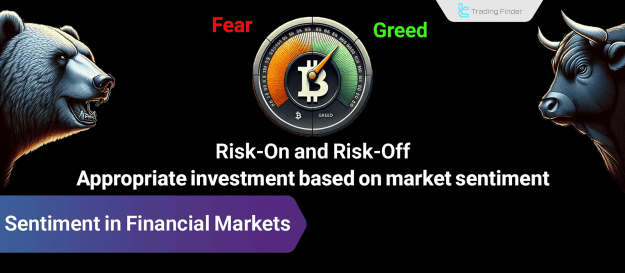


- Risk-averse sentiment reflects fear of asset declines, prompting traders to invest in safe-haven assets like gold and bonds.
- Risk-on sentiment signifies traders' greed for price increases, leading them to buy risky assets such as cryptocurrencies and stocks.
TP & SL Tool: Risk Reward Ratio Calculator RRR MT5 | Prop Firm Protector: Trade Assist Prop Firm Plus TF Expert MT5 | Money Management + DrawDown Protector: Trade Panel Prop Firm Drawdawn Limiter Pro MT5 |Get a free Expert Advisor license via Telegram and WhatsApp
What is Market Sentiment?
Market sentiment, whether risk-on or risk-off, is shaped by a confluence of factors, including news, economic data, and existing risks. Understanding this prevailing sentiment is crucial for optimizing investment strategies.
Risk-On Sentiment
Risk-on sentiment typically emerges when economic data points towards expansionary monetary policy. This occurs when the market anticipates lower interest rates, increased liquidity, and growth in the prices of risky assets. However, it's not solely dependent on economic data; any factor that reduces uncertainty can foster risk-on sentiment.
Example of Risk-On Sentiment: For instance, at the conclusion of a contractionary cycle (characterized by high interest rates to combat inflation), risk-on sentiment will materialize if inflation data is lower than expected, strengthening expectations of interest rate cuts. Assets likely to appreciate during risk-on sentiment include:
- Stock market
- Cryptocurrency market
Risk-Off Sentiment
Conversely, risk-off sentiment drives demand for safe-haven assets like gold and bonds. This sentiment arises when economic data suggests contractionary monetary policy or when risk and uncertainty dominate the market outlook. Beyond economic indicators, political and geopolitical risks, or any general uncertainty about the future, can exacerbate risk-off sentiment.
Example of Risk-Off Sentiment: For example, if, at the end of a contractionary cycle, economic inflation data is higher than anticipated, expectations of interest rate cuts will weaken. This can lead to a risk-off sentiment as high interest rates persist, maintaining low liquidity levels.
Categorizing Assets Based on Their Fundamentals
After identifying the prevailing market sentiment, investors can strategically select appropriate assets. Certain Forex market currencies, for example, possess inherent risk-on or risk-off characteristics, which are amplified or diminished according to the prevailing market sentiment.
- Risk-On Assets: CAD, AUD, NZD, Stock Market, Bitcoin, Ethereum
- Risk-Off Assets: AUD, CHF, JPY, USD, Gold, Bonds
- No Specific Sentiment: AUD, EUR, GBP
How to Identify Market Sentiment?
Market sentiment is often reflected through asset price fluctuations. For instance, if risk-on currencies strengthen while safe-haven currencies weaken, it typically indicates a risk-on environment, as demand for riskier assets has increased.
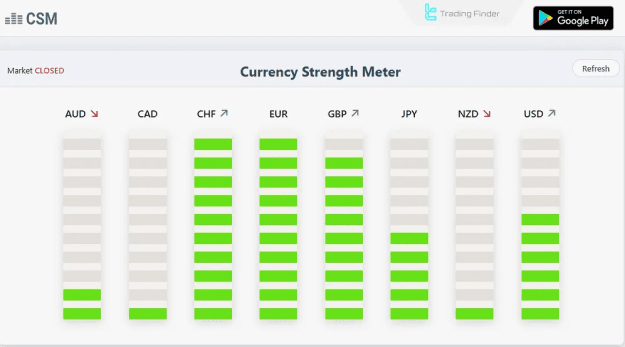
Identifying Market Sentiment on CSM Website
Observing currency strength on platforms like the CSM website provides a valuable tool for assessing market sentiment. Currency strength is typically indicated by visual representations, such as bar heights. For example, the simultaneous strength of the US Dollar, Japanese Yen, and Swiss Franc often suggests a risk-off market sentiment. However, the strength of a risk-on currency like the Canadian Dollar in such an environment might be attributable to other factors, such as rising oil prices or domestic economic news.
Fear and Greed Index in the Cryptocurrency Market
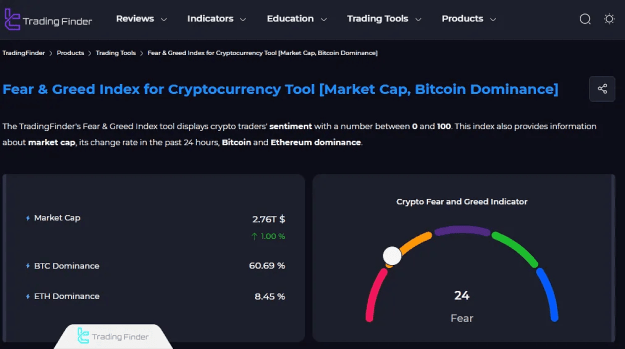
The Fear and Greed Index is specifically utilized to gauge trader sentiment in the cryptocurrency market. This index, ranging from 0 to 100, signals escalating levels of fear or greed among market participants.
- A value in the "Extreme Fear" zone (below 25), often observed during sharp price declines, can indicate a potential buying opportunity.
- Conversely, a reading in the "Extreme Greed" zone (above 75), common during price surges, is often considered a signal to sell or take profit.
Tools like the TradingFinder Cryptocurrency Fear and Greed tool can be used to monitor this sentiment.
VIX Fear Index
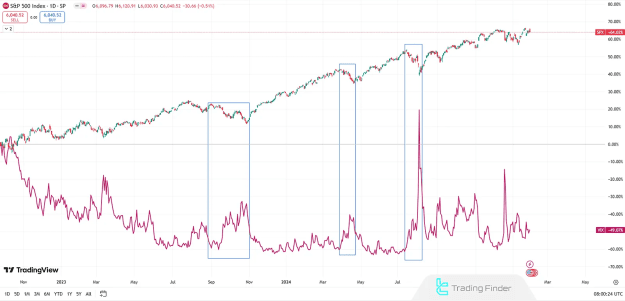
The VIX Fear Index measures the market's expectation of volatility in the S&P 500 over the next 30 days, serving as an indicator of fear and uncertainty (risk-off sentiment).
- A rising VIX index signifies increased fear and uncertainty.
- Conversely, a downward trend in the VIX suggests that investors anticipate reduced volatility and uncertainty, indicating risk-on sentiment.
There is an inverse relationship between the VIX index and the S&P 500, meaning as the VIX rises, the S&P 500 often declines, reflecting increased fear.
Can the Market Lack a Specific Sentiment?
Occasionally, the market may lack a dominant sentiment, and its movements proceed naturally without being heavily influenced by widespread emotions. Sentiment typically solidifies in the market following the release of significant events or economic data, such as central bank meetings, key economic reports, or specific news.
Conclusion
In conclusion, understanding traders' sentiment is fundamental to navigating market fluctuations. By predicting emotions through data and news, identifying sentiment by monitoring market fluctuations, and understanding the intrinsic nature of assets, investors can optimize their investment decisions. Tools such as the Fear and Greed Index, the VIX, and currency strength indicators are invaluable for identifying prevailing market sentiment.