

TP & SL Tool: Risk Reward Ratio Calculator RRR MT5 | Prop Firm Protector: Trade Assist Prop Firm Plus TF Expert MT5 | Money Management + DrawDown Protector: Trade Panel Prop Firm Drawdawn Limiter Pro MT5 |Get a free Expert Advisor license via Telegram and WhatsApp
What is the ICT Weekly Range Expansion Model?
In the context of ICT (Inner Circle Trader) methodology, the Weekly Range Expansion Model is a specialized short-term trading strategy aimed at capitalizing on predictable weekly market movements. This model is built upon three fundamental components, often referred to as PD Arrays (Price Delivery Arrays):
- Fair Value Gap (FVG): These are price inefficiencies that occur due to rapid market movements, creating a "gap" that the price often seeks to retrace and fill.
- Old Lows/Highs: These represent historical price points where significant liquidity is typically concentrated, acting as potential price targets or reversal zones.
- Liquidity Pool: These are areas where stop-loss orders accumulate, attracting price to move towards them to "sweep" the available liquidity.
This versatile model is applicable across various financial markets, including the Forex market, stocks, and cryptocurrencies, making it a valuable tool for diverse trading portfolios.
Steps to Implement the ICT Weekly Range Expansion Model
Implementing the ICT Weekly Range Expansion Model involves a structured, three-step process to identify and execute high-probability trades:
#1 Determine Weekly Direction
The initial and crucial step is to ascertain the prevailing weekly market direction. This involves a thorough analysis of the weekly chart, specifically looking for price action that aims to fill Fair Value Gaps or target existing liquidity pools.
- If the market is consistently forming higher highs and exhibits a bullish structure, your weekly bias should be bullish.
- Conversely, if the price is creating lower lows, indicating a bearish structure, the bias will be bearish.
#2 Identify the Range Expansion Setup
Once the weekly direction is established, the next step is to pinpoint the price range expansion. Typically, the market establishes a defined range early in the week, often on Monday.
The actual range expansion is expected to occur from Tuesday to Thursday. Confirming this expansion often involves analyzing lower timeframes, such as the daily chart, to observe the unfolding price action.
#3 Execute the Trade
Based on the confirmed weekly bias and the identified range expansion setup, trades are executed with precision timing:
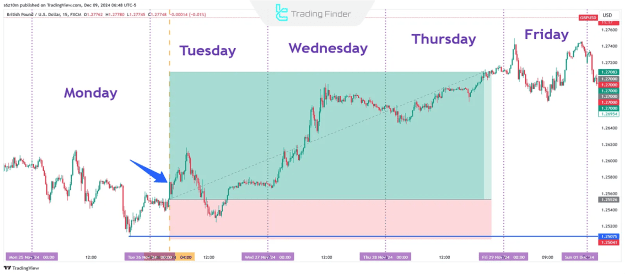
- For a bullish bias, initiate a buy trade on Tuesday at 4:00 AM (New York time), aligning with the opening of the candle.
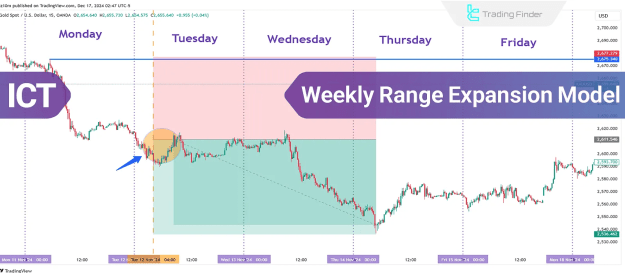
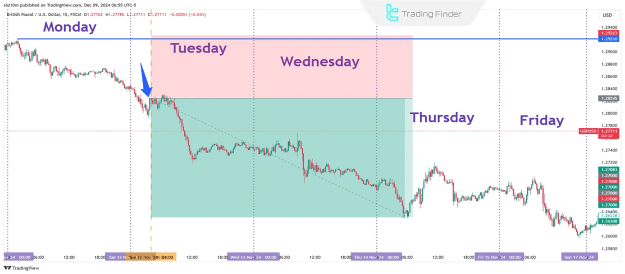
- For a bearish bias, execute a sell trade at the same precise time.
How to Trade a Bullish Weekly Expansion?
To effectively trade a bullish weekly expansion, adhere to the following systematic approach:
- Confirm Weekly Bullish Bias: Verify that sell-side liquidity has been taken or that the price has entered a discount PD Array.
- Target Price: Anticipate price movement towards buy-side liquidity or premium zones.
- Confirm Structure: Look for a definitive market structure shift (MSS) to a bullish bias on the daily timeframe.
- Execution Timing: Enter buy trades from Tuesday and aim to hold the position until Thursday.
How to Trade a Bearish Weekly Expansion?
For executing bearish trades within this model, the process mirrors the bullish scenario but with a bearish confirmation:
- Confirm Weekly Bearish Bias: Look for buy-side liquidity being taken or the price reaching a premium PD Array.
- Target Price: Expect price to move towards sell-side liquidity or discount zones.
- Confirm Structure: Ensure a clear market structure shift (MSS) to a bearish bias on the daily timeframe.
- Execution Timing: Enter sell trades on Tuesday and hold the position until Thursday.
Key Considerations in Using the ICT Weekly Range Expansion Model
To successfully apply the ICT Weekly Range Expansion Model, traders must pay attention to several critical factors:
- Determine Weekly Bias Accurately: A precise review of the weekly timeframe is paramount for identifying the primary price direction. For instance, if sell-side liquidity was recently swept and the price is within a discount PD Array, a bullish movement in the upcoming week is highly probable.
- Align Timeframes: It is crucial to use the daily timeframe to corroborate the weekly bias. A bullish market structure shift (MSS) on the daily chart, for example, strongly confirms a bullish weekly bias.
- Entry Timing: The optimal entry point is typically on Tuesday, as this marks the beginning of the anticipated range expansion phase.
- Logical Stop-Loss Placement: This model generally advocates for tight stop losses, which is a key element in effective risk management.
Common Mistakes When Using the ICT Weekly Range Expansion Model
Traders often encounter specific pitfalls when applying this model. Awareness of these common mistakes can significantly improve trading outcomes:
- Incorrect Weekly Bias Determination: Misinterpreting liquidity zones, premium, and discount areas can lead to an inaccurate weekly bias.
- Entering Too Early or Too Late: Executing trades before the necessary confirmations are in place or after the primary expansion phase has concluded can result in suboptimal outcomes.
- Ignoring Lower Timeframes: Failing to analyze market structure shifts (MSS) on lower timeframes can lead to misjudged trades.
- Overlooking News Events: Economic releases and significant macro news can profoundly impact weekly trends. Disregarding these events can lead to incorrect trade timing and unexpected market movements.
Conclusion
The ICT Weekly Range Expansion Model stands as an exceptionally potent tool for traders seeking to enhance their trading precision and overall efficiency. By skillfully integrating market structure analysis, meticulous liquidity identification, and precise timing, this model empowers traders to effectively capitalize on significant weekly price movements.