

TP & SL Tool: Risk Reward Ratio Calculator RRR MT4 | Prop Firm Protector: Trade Assist Prop Firm Plus TF Expert MT4 | Money Management + DrawDown Protector: Trade Panel Prop Firm Drawdawn Limiter Pro MT4 |Get a free Expert Advisor license via Telegram and WhatsApp
What is an Inverse Fair Value Gap (IFVG)?
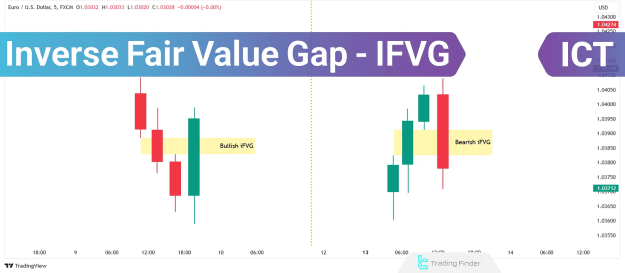
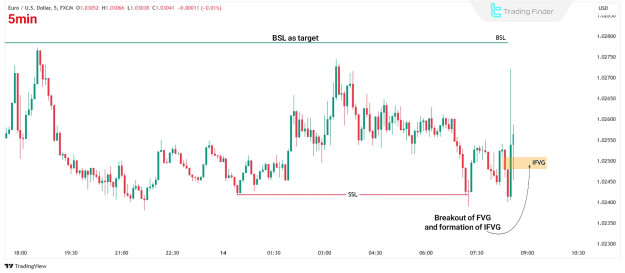
An Inverse Fair Value Gap (IFVG) is essentially an FVG that fails to sustain price movement in its original intended direction. Despite this initial invalidation, it paradoxically transforms into a potent supply or demand zone in the contra-direction. In most trading scenarios, price action will retrace to this newly established IFVG zone, utilizing it as a foundational level for subsequent price reversals.
Advantages and Limitations of Inverse Fair Value Gaps (IFVG)
Like all technical analysis tools, trading based on the Inverse Fair Value Gap presents distinct advantages and disadvantages.
Advantages:
- Early Reversal Signals: IFVGs can provide proactive indications of potential price reversal points.
- Enhanced Entry Opportunities: They enable traders to identify and execute early trade entries.
- Improved Risk-Reward Ratios: Effective utilization of IFVGs can lead to more favorable risk-reward propositions.
Limitations:
- Potential for False Signals: IFVGs can, at times, generate misleading signals, requiring careful confirmation.
- Market Condition Dependency: Their reliability is often contingent on prevailing market conditions and volatility.
- Integration Requirement: Optimal effectiveness necessitates integration with other ICT principles and analytical tools.
Types of Inverse Fair Value Gaps
Inverse Fair Value Gaps are categorized into two primary types: Bullish and Bearish.
Bullish Inverse Fair Value Gap (Bullish IFVG)
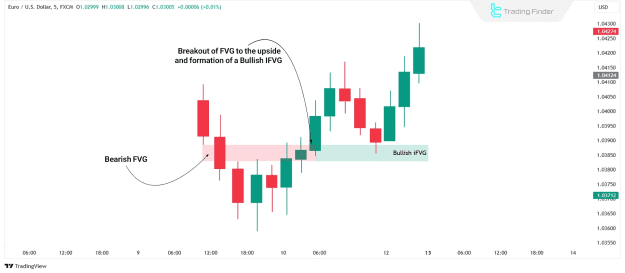
A Bullish IFVG forms when a Bearish FVG, which aimed to push prices lower, is invalidated by an upward price breach. Following this invalidation, the level transitions into a demand zone, subsequently initiating and supporting bullish price movements.
Bearish Inverse Fair Value Gap (Bearish IFVG)
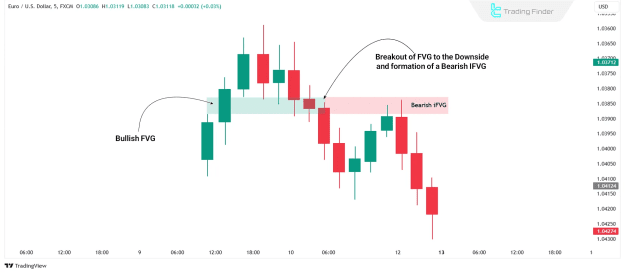
Conversely, a Bearish IFVG occurs when a Bullish FVG, intended to support upward price movement, is broken downward. This invalidation transforms the zone into a supply area, from which bearish price action typically commences.
Identifying High-Probability Inverse Fair Value Gaps
While Inverse Fair Value Gaps can appear anywhere on a price chart, certain conditions increase their probability of leading to successful trades.
#1 Liquidity Areas
IFVGs that manifest after a liquidity sweep from key zones are considerably more reliable. These crucial liquidity areas include:
- Daily Highs and Lows (HOD/LOD)
- Session Highs and Lows
- Equal Highs and Lows
- Established Support and Resistance Zones
- Significant Swing Highs and Lows
In a downtrend, liquidity inducement zones (IDM), often represented by lower highs, are frequently cleared by price before the bearish trend resumes.
#2 Premium and Discount Zones (PD Zones)
Identifying Premium and Discount Zones is another effective method for pinpointing high-probability IFVGs. These zones are defined as follows:
- In an uptrend, the discount zone constitutes the lower half of a price move, while the premium zone represents the upper half.
- Price typically retraces at least 50% into a discount before continuing its trend. Consequently, supply or demand zones that align within the discount area are more likely to successfully hold price.
How to Trade Using Inverse Fair Value Gaps (IFVG)
The IFVG is not a standalone trading strategy but rather a foundational concept that deepens understanding of price behavior. Its effectiveness is maximized when integrated with other ICT principles.
#1 Identifying Liquidity Sweep
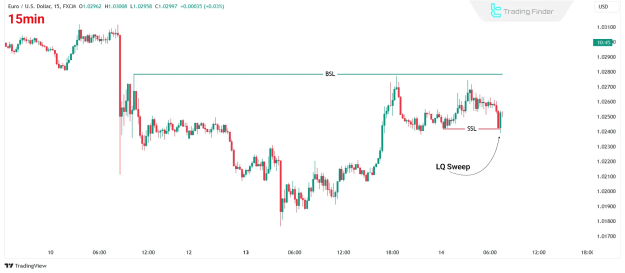
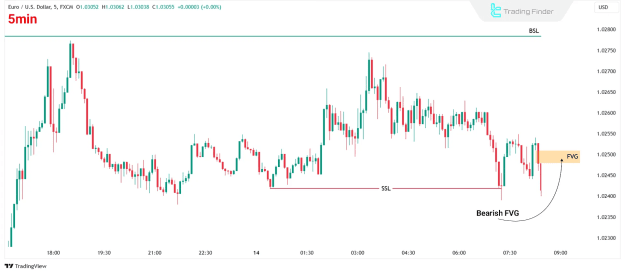
The initial step involves recognizing liquidity areas that are likely to be swept before the anticipated trend continuation. Ideally, this liquidity should reside on the side opposite to your expected directional bias. For example, if a bullish move is anticipated on the EUR/USD, a notable swing low representing sell-side liquidity would be a prime candidate for a sweep.
#2 Trade Entry
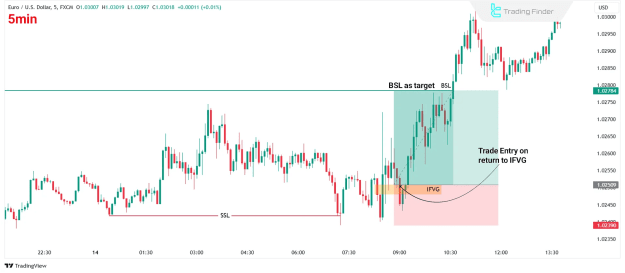
Following a liquidity sweep, the next step is to identify the regular FVG that forms on the chart. Subsequently, observe and wait for price to breach this FVG in the opposite direction, which confirms the formation of the Inverse Fair Value Gap (IFVG).
#3 Risk Management
Robust risk management is paramount when trading with IFVGs. Consider the following guidelines for stop-loss and take-profit placement:
- Stop Loss (SL): Position your stop loss strategically below the nearest low (for long positions) or above the nearest high (for short positions) that precedes the IFVG formation.
- Take Profit (TP): Set your take profit at a significant high or low that aligns with the opposing side of your trade, such as a major liquidity target.
Conclusion
The ICT Inverse Fair Value Gap (IFVG) serves as an advanced analytical tool, instrumental in identifying critical entry and exit points within financial markets. Its formation signifies an FVG's invalidation in its initial direction, subsequently transforming it into an effective and powerful zone for price action in the opposite direction.