

TP & SL Tool: Risk Reward Ratio Calculator RRR MT4 | Prop Firm Protector: Trade Assist Prop Firm Plus TF Expert MT4 | Money Management + DrawDown Protector: Trade Panel Prop Firm Drawdawn Limiter Pro MT4 |Get a free Expert Advisor license via Telegram and WhatsApp
A Comprehensive Guide to the ICT 2022 Mentorship Trading Strategy
The ICT 2022 Mentorship trading strategy is a distinctive methodology that synergizes market liquidity with precise timing to pinpoint highly accurate entry and exit points, utilizing advanced tools such as Fair Value Gaps (FVG), Order Blocks, and Breaker Blocks. A key characteristic of this strategy is the seamless alignment of price movement with the London and New York trading sessions, wherein it concentrates on identifying liquidity at pivotal market highs and lows, emphasizing Daily Bias recognition and multi-timeframe market behavior analysis to provide a cohesive framework designed for a minimum risk-to-reward ratio of 1:3. By focusing on liquidity sweeps and market structure shifts (MSS), the ICT 2022 trading strategy offers a clear and popular pathway for day traders within the financial markets.
What is the ICT 2022 Mentorship Trading Strategy?
The ICT 2022 Mentorship trading model is an algorithm-based strategy that utilizes principles of price imbalance and market liquidity. A core element of this strategy is synchronizing price movements with specific time intervals, particularly the opening of the London and New York sessions.
To implement the ICT 2022 Mentorship trading model, a trader must first identify the daily bias, which is the prevailing daily trend (either bullish or bearish). Next, they must mark key liquidity points, such as daily highs and lows or those from prior sessions.
Michael Huddleston's strategy, employing tools like Fair Value Gaps (FVG), Order Blocks, and Displacement Moves, enables traders to execute precise trades. Entry confirmations typically occur with market structure shifts (MSS) and price retracements to premium or discount zones.
How Does the ICT 2022 Trading Model Work?
The ICT Mentorship 2022 strategy involves a systematic approach:
- Identifying Daily Bias: The initial step for successful application is accurately determining the daily bias. This aligns trades with the dominant market trend.
- Awaiting the Opening of the London Session: After establishing the daily bias, wait for the London session to open at 03:00 AM New York Time.
London Session Trading Strategy (Step-by-Step Process)
The London session trading strategy involves several key steps:
- Identify the Highs and Lows of the Price Range: Before the London session opens at 03:00 AM (New York time), mark the highs and lows of the price range from the midnight New York session opening (12:00 AM) to the London session opening.
- Wait for Price Movement: Once the London session begins, wait for the price to move to one of these levels (high or low) and sweep liquidity. This movement is referred to as a Liquidity Sweep.
- Observe Market Structure Shifts (MSS): After the liquidity sweep, transition to lower timeframes (5, 3, or even 1 minute) and look for a market structure shift. This shift should align with the daily bias of the ICT strategy.
- Identify Key Areas (PD Array): Utilize tools to identify key areas like Fair Value Gaps (FVG), Order Blocks, or Breaker Blocks within premium or discount zones.
- Wait for Price to Retrace to the PD Array Area: Exercise patience until the price retraces to one of the identified areas.
- Execute the Trade: For a sell trade, place the stop loss above the London session high and aim for the range low as the take profit. For a buy trade, set the stop loss below the London session low and target the range high for the take profit.
- Monitor the Trade: Manage the trade after entry, ensuring a minimum risk-to-reward (R:R) ratio of 1:3 is maintained.
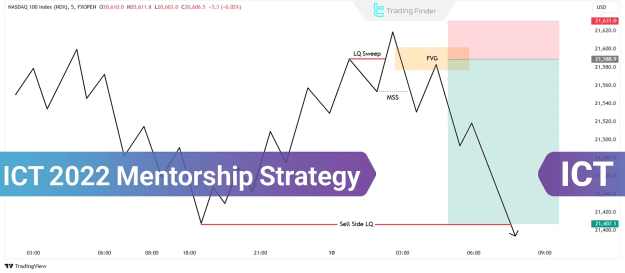
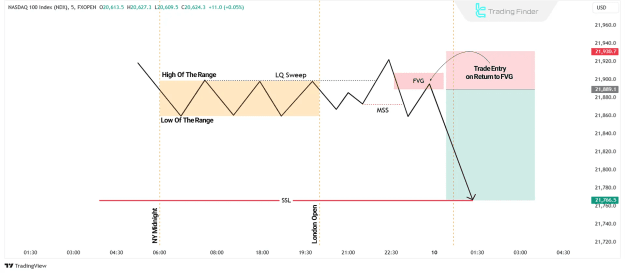
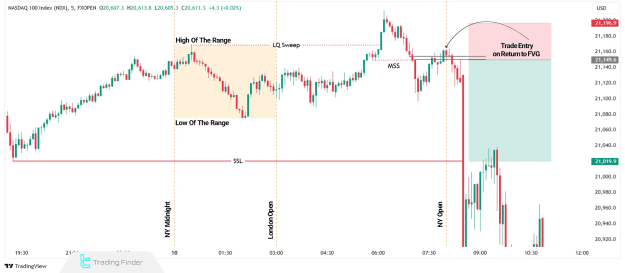
As illustrated in the 5-minute Nasdaq Index chart, the highs and lows of the price range before the London session opening are marked. During the London session, the price breaks above the range high, sweeping liquidity, and then initiates a downtrend (market structure shift - MSS). As the New York session opens, the price retraces to the London range and encounters a Fair Value Gap (FVG). At this juncture:
- A sell trade is executed with a stop loss above the London high and take profit at the range low.
- The price sweeps the range low, and the trade successfully concludes.
Why is the London Session an Ideal Time to Trade?
The London session frequently exhibits high volatility and presents numerous profit-making opportunities. This is largely due to its simultaneous overlap with the London Kill Zone Open.
New York Session Trading Strategy
The New York session commences at 08:00 AM (New York Time). Two primary scenarios typically occur during this session:
- Liquidity is swept during the London session.
- The London session remains in a narrow range.
Each of these scenarios is detailed below for trading with the ICT 2022 Mentorship model during the New York session.
If Liquidity is Swept During the London Session
When liquidity is swept in the London session, the New York session may initially experience a retracement before continuing the London session's trend.
- Draw a Fibonacci retracement from the London session low to the high before the New York retracement.
- Wait for the price to touch the Optimal Trade Entry (OTE) levels.
- Execute the trade only after confirming a market structure shift (MSS) in lower timeframes (e.g., 1 minute).
If the London Session Remains in a Narrow Range
Follow these steps to optimize trading opportunities when the London session is confined within a narrow range without significant movement:
- Identify the Highs and Lows of the Range: Mark the highs and lows of the price range from the London session opening at 12:00 AM to the New York session opening at 08:00 AM. This range represents the price movement during the London session where liquidity may remain unswept.
- Wait for the New York Session to Open: After the New York session begins, price typically sweeps liquidity on one side of the range (either the high or low).
- Identify the Liquidity Sweep: Monitor price movements to identify the liquidity sweep of the range high or low. This movement usually triggers a market structure shift.
- Observe Market Structure Shifts (MSS): After the liquidity sweep, switch to lower timeframes (e.g., 5, 3, or 1 minutes) and look for a market structure shift that aligns with the daily ICT bias.
- Identify Key Areas (PD Array): Use tools to determine key areas like Fair Value Gaps (FVG), Order Blocks, or Breaker Blocks. These areas are usually visible in lower timeframes and within discount or premium zones.
- Wait for Price Retracement: Exercise patience until the price retraces to the key areas identified in the previous step. This retracement often follows a market structure shift.
- Execute the Trade: For a buy trade, set the stop loss below the Order Block low and take profit at the range high. For a sell trade, place the stop loss above the Order Block high and target the range low for the take profit.
- Trade Management: Manage the trade to ensure a minimum risk-to-reward (R:R) ratio of 1:3 is maintained.
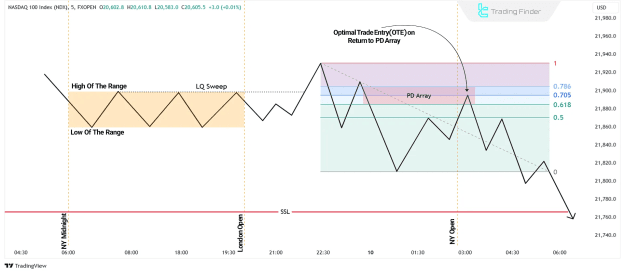
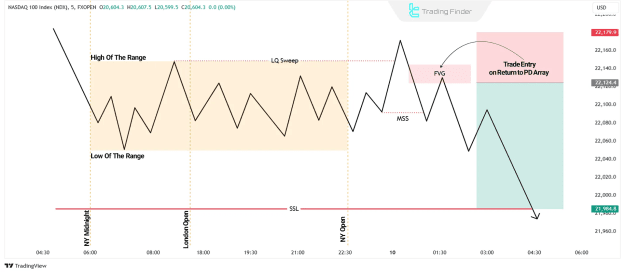
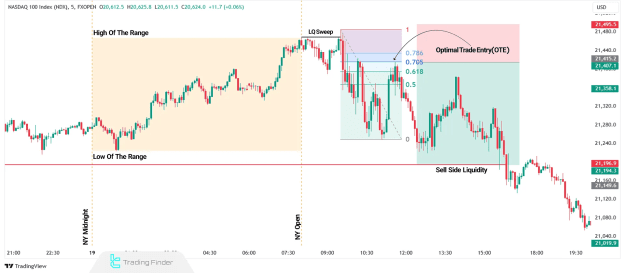
In the 5-minute Nasdaq chart example, the highs and lows of the price range before the New York session opening are marked. During the London session, no significant price movement or liquidity sweep occurs. After the New York session opens, the price first sweeps the range high. The price then retraces and experiences a market structure shift. Subsequently, the price moves towards the Fibonacci Optimal Trade Entry (OTE) level (70.5%), where a sell trade is executed:
- Stop Loss: A few pips above the recent high.
- Take Profit: At the range low.
The price successfully reaches the range low, completing the trade with a risk-to-reward ratio of 1:3.
Key Time Zones for the ICT 2022 Mentorship Trading Model
The table below outlines the critical ICT kill zones for the ICT 2022 Mentorship setup across two time zones:
- Midnight New York Open: 04:00 AM GMT / 12:00 AM (Midnight) EST
- London Session Open: 07:00 AM GMT / 03:00 AM EST
- New York Session Open: 12:00 PM GMT / 08:00 AM EST
- New York Lunch Time: 04:00 PM - 06:00 PM GMT / 12:00 PM - 02:00 PM EST
- London Session Close: 04:00 PM GMT / 12:00 PM EST
During the lunch hours of the New York session (12:00 PM to 02:00 PM EST), price typically moves within a defined range or retraces to a previous range. This behavior is attributed to decreased trading activity during lunch.
Key Timeframes in the ICT 2022 Mentorship Trading Strategy
Each timeframe in the ICT Mentorship 2022 trading setup holds specific importance and application:
- Daily Timeframe: Used to determine the daily ICT bias.
- 1-Hour Timeframe: Provides an overall view in a higher timeframe.
- 15-Minute Timeframe: Used to identify liquidity and price imbalance.
- 5-, 3-, and 1-Minute Timeframes: Employed for final confirmation and trade execution.
Types of Liquidity
Understanding different types of liquidity is crucial for this strategy:
- Previous Day High/Low (PDH/PDL): Refers to the highs and lows of the prior trading day.
- Previous Session High/Low: Refers to the highs and lows of the most recent session.
- Previous Week High/Low: Refers to the highs and lows of the last trading week.
- Consolidated Highs/Lows in the 15-Minute Timeframe: Represents liquidity accumulation visible in this timeframe.
- Return to the Gap of the Current or Previous Week’s Open (NWOG): Price returning to a weekly gap.
- Return to the Gap of the Current or Previous Day’s Open (NDOG): Price returning to a daily gap.
Optimal Trading Times for the ICT 2022 Mentorship Model
The opening of the New York session offers the best opportunities for trading using Michael's ICT Mentorship 2022 strategy. This timeframe aligns with the New York AM Session Kill Zone and overlaps with the London session, leading to significant volatility.
Best Currency Pairs for the ICT 2022 Mentorship Model
The ICT 2022 Mentorship strategy can be applied across all markets. However, its highest efficiency is observed in major indices like the NASDAQ100 (NQ-Futures) and E-mini (S&P 500). It also delivers excellent results when trading major currency pairs involving the US dollar, such as GBP/USD, EUR/USD, and precious metals like Gold (XAU/USD).
Conclusion
The ICT 2022 Mentorship trading strategy emphasizes key elements such as session timing, liquidity identification, and market structure shifts (MSS) to help traders analyze market movements with greater precision. By focusing on critical points like Fair Value Gaps (FVG) and Order Blocks, the model facilitates entries into trades with a high risk-to-reward ratio.